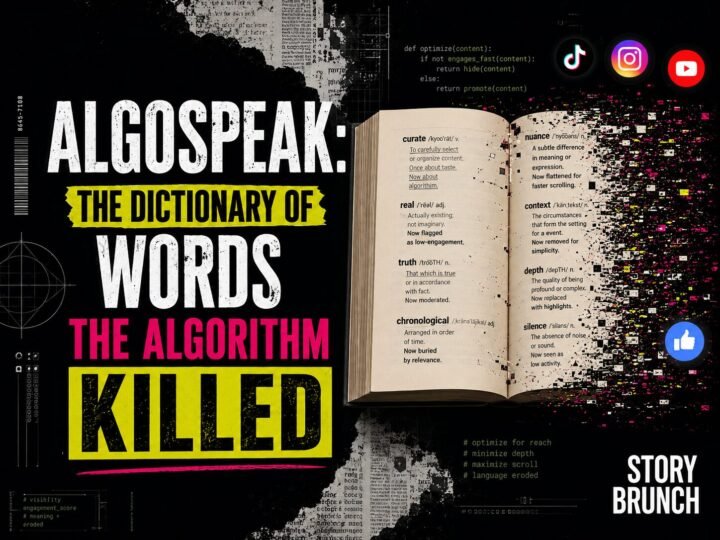
Algospeak: The Dictionary of Words the Algorithm Killed

Internet & Culture · Decoder Ring Nº 01
Algospeak: The Dictionary of Words the Algorithm Killed
A field guide to the fastest language change in human history — the words we stopped saying because the machines were listening, and the strange new tongue we invented instead.
This post may be suppressed for describing itself
Read this sentence, transcribed from the internet in its natural habitat:
“Before I tell this unalive-adjacent story — my last account got zucced, so fair warning — the seggs talk starts now: my accountant era got pretty spicy, the panini made everything worse, and if this video disappears, find me at the blink in lio.”
Plaintext translation“Before I tell this story about a suicide attempt — my last account was banned, so fair warning — the sex talk starts now: my time doing sex work got pretty explicit, the pandemic made everything worse, and if this video is removed, the link is in my bio.”
Every substitution in that sentence exists for one reason: somewhere between the speaker and her audience sits an automated moderation system, and she is talking around it. Not to deceive her viewers — they decode it instantly — but to slip past a classifier that might suppress, demonetize, or delete her for using the plain words.
Linguists have watched languages route around taboos for as long as there have been taboos. What they have never watched before is the enforcer being a machine, the penalty being invisibility, and the mutation happening at the speed of a trending sound. This is a dictionary of that mutation: what died, what replaced it, and what it costs to speak a language your own platforms are afraid of.
The short answer, before the long one
Algospeak is the code language users invent to evade automated content moderation on social platforms — substituting words they believe will get their posts suppressed, demonetized, or removed (“unalive” for kill or suicide, “seggs” for sex, “grape” for rape, the corn emoji for porn). The term spread widely after Taylor Lorenz’s 2022 Washington Post reporting, and the practice has since been studied academically, including a 2023 study in Social Media + Society on how TikTok users deploy it to contest and evade moderation.
Linguistically, algospeak is the newest ride on what Steven Pinker named the euphemism treadmill — the ancient cycle in which taboo words get replaced, the replacements absorb the taboo, and get replaced again. What’s new is the enforcer and the tempo: past taboos were policed by priests, censors, and social disapproval over generations; algospeak is policed by opaque classifiers and folk theories about them, and a substitution can be coined, adopted by millions, detected, and replaced within months. It is the euphemism treadmill at machine speed — and its costs, from crisis resources that can’t be searched to classrooms where teenagers say “unalive” out loud, are only beginning to be counted.
Entry I · The Mechanism
Why a machine’s guess became a grammar
To understand algospeak you have to understand what it’s dodging — and the strange fact that nobody, including the dodgers, knows exactly what that is.
Modern platforms moderate at a scale no human workforce could touch, so the first pass is automated: classifiers scan text, audio, and captions for content that violates policy or unsettles advertisers. The penalties for tripping them range from deletion to the subtler and more feared outcome — suppression, the state users call shadowbanning, where content is quietly shown to fewer people with no notice given. Platforms rarely confirm which words trigger what. That opacity is the crucial ingredient, because it means users don’t respond to the actual rules; they respond to their folk theories of the rules — beliefs assembled from personal experiments, creator rumor mills, and pattern-matching on which videos underperformed.
The academic work bears this out. The 2023 Social Media + Society study of algospeak on TikTok (Steen, Yurechko & Klug) documented users building elaborate substitution systems based substantially on perceived moderation — a collective defense against a rulebook nobody has read. And a 2023 study in American Speech by linguists Kendra Calhoun and Alexia Fawcett — memorably titled after a creator’s complaint that TikTok “edited out her nip nops” — catalogued the remarkable range of self-censorship strategies creators apply to ordinary words for bodies, identities, and harm, from respellings to emoji rebuses to prosodic workarounds in speech itself.
Notice what this means: the algorithm doesn’t have to ban a word to kill it. It only has to make speakers believe the word is dangerous. The chilling effect does the rest, and the treadmill starts turning — which is why half the entries in the dictionary below replaced words that may never have been on any list at all.
The algorithm doesn’t have to ban a word to kill it. It only has to be suspected.
Entry II · The Dictionary
Thirty entries from the new tongue
Each entry records the substitute, the plain word it replaced, and the etymology — because these words have etymologies now, and some are genuinely strange. Filter by what kind of speech was being routed around.
unalive v., adj.
→ replaces: die, kill, suicide
Etymology & cause of deathThe flagship of the entire lexicon. Creators discussing true crime, war, grief, and mental health adopted it to keep videos monetized and visible; variants (“self-unalive,” “sewer slide”) followed as the treadmill turned. Now documented in student essays and spoken classroom English — the clearest case of algospeak escaping the platform that bred it.
seggs n.
→ replaces: sex
Etymology & cause of deathA phonetic respelling built to survive both text filters and speech-to-text captioning — it sounds right aloud while matching nothing on a wordlist. Used heavily by sex-education creators, whose entire subject sits inside the suppression zone.
le dollar bean n.
→ replaces: lesbian
Etymology & cause of deathThe lexicon’s accidental masterpiece. Users first wrote “le$bian” to dodge suspected suppression; TikTok’s text-to-speech voice then read the respelling literally as “le dollar bean,” and the machine’s mispronunciation became the word. A coinage jointly authored by a community and the very system it was evading.
corn / 🌽 n.
→ replaces: porn
Etymology & cause of deathRhyme plus rebus: the emoji carries the meaning while matching no banned string. Spawned an ecosystem (“corn star,” anti-corn activism using the same code) — evasion and its opposition speaking the same cipher.
grape n., v.
→ replaces: rape
Etymology & cause of deathNear-rhyme substitution used overwhelmingly by survivors telling their own stories — the community with the most urgent need to speak sitting closest to the suppression tripwire. The grape emoji serves as the written form; “SA” (below) is its clinical sibling.
SA abbr.
→ replaces: sexual assault
Etymology & cause of deathInitialism as armor. Now so standard in survivor communities that the full phrase reads as unusual on-platform — a taboo replacement completing its life cycle in roughly three years.
pew pews n. pl.
→ replaces: guns, firearms
Etymology & cause of deathOnomatopoeia standing in for the noun — a child’s sound effect adopted by adult firearms channels to survive advertiser-safety systems. The euphemism is more whimsical than anything it describes, which is rather the point.
accountant n.
→ replaces: sex worker, adult creator
Etymology & cause of deathFrom a viral 2020 song by Rocky Paterra — “I’m an accountant” as the answer that ends all follow-up questions. Adopted sincerely by adult creators as a job title the classifiers can’t object to; “spicy accountant” marks the explicit tier.
leg booty n.
→ replaces: LGBTQ
Etymology & cause of deathPhonetic camouflage for the initialism itself, born of community suspicion — supported by reporting on moderation systems — that queer identity terms were being down-ranked as inherently “adult.” An identity encrypting its own name to stay visible.
cornucopia n.
→ replaces: homophobia
Etymology & cause of deathLoose sound-alike (“-cop-” carrying “-phob-‘s” slot) that lets creators name the discrimination they’re describing without tripping filters tuned to slur-adjacent vocabulary. Naming the harm had become as risky as the harm’s own language.
panini / panoramic n.
→ replaces: pandemic
Etymology & cause of deathWhen platforms suppressed COVID-19 content to fight misinformation, they suppressed everyone discussing the defining event of the era — so the era renamed itself after a sandwich. Sibling forms: “panorama,” “Miss Rona,” and the gloriously baroque “Backstreet Boys reunion tour.”
camping v.
→ replaces: seeking abortion access
Etymology & cause of deathCoined within days of Roe v. Wade’s 2022 overturn: posts offered to take friends “camping” in states where “camping” remained legal. Algospeak’s clearest demonstration that the technique scales from advertiser-friendliness to genuine legal risk.
nip nops n. pl.
→ replaces: nipples
Etymology & cause of deathCutesy reduplication for an anatomical term creators believed unsayable — immortalized when linguists Calhoun and Fawcett titled their American Speech study after a creator’s complaint that TikTok “edited out her nip nops.” The word entered the academic record before the dictionary.
spicy adj.
→ replaces: sexual, explicit
Etymology & cause of deathThe lexicon’s general-purpose adjective — “spicy content,” “spicy book” (romance BookTok’s entire economy runs on it). A euphemism so successful it’s now marketing language, which is how you know the treadmill is due to turn again.
mascara n.
→ replaces: romantic/sexual partner or encounter (incl. assault contexts)
Etymology & cause of deathFrom a 2022 TikTok trend using makeup as extended metaphor — and the lexicon’s cautionary tale. The code was so ambiguous that outsiders (famously including celebrity commenters) misread serious disclosures as literal cosmetics talk, while actual mascara reviews got swept into the confusion. Codes protect speech from machines at the price of clarity with humans.
zucced v., past part.
→ replaces: banned / removed (on Meta platforms)
Etymology & cause of deathEponym from Mark Zuckerberg — moderation personified as a verb, the way “bowdlerize” once immortalized a censor. Proof the lexicon doesn’t just evade the system; it names and mocks it.
blink in lio n. phr.
→ replaces: link in bio
Etymology & cause of deathSpoonerized to dodge suspected down-ranking of posts that pull users off-platform. Nothing taboo about the phrase at all — which makes it the purest specimen in the collection: a word killed not for what it means but for what it costs the platform.
in Minecraft suffix
→ replaces: nothing — it appends deniability
Etymology & cause of deathBorn on forums as a magic suffix that recasts any violent statement as a joke about a video game. Unlike most algospeak it evades not the filter but the consequence — a plausible-deniability spell. Moderators and, in several documented cases, courts have declined to honor the spell, which is worth knowing before anyone relies on it.
🍆 🍑 emoji cipher
→ replaces: anatomy, in full
Etymology & cause of deathThe elder statesmen of the lexicon. Emoji-as-innuendo predates the word “algospeak” by years — Instagram blocked the eggplant emoji from hashtag search as far back as 2015, an early admission that platforms and users were already at war over a vegetable. The produce aisle has been load-bearing ever since (see also: corn, grape).
ouid n.
→ replaces: weed
Etymology & cause of deathTake “weed,” swap the w for an o, wear it like a fake moustache. Cannabis creators — including legal-market ones — adopted it to survive drug-content filters that don’t distinguish jurisdiction. A tidy example of the treadmill’s absurdity: the filter knows what ouid means by now; everyone involved is politely pretending otherwise.
grippy sock vacation n.
→ replaces: psychiatric hospitalization
Etymology & cause of deathNamed for the non-slip socks issued on inpatient wards, and coined by the people who wore them. Part filter-evasion, part gallows humor that makes a hard experience speakable. Clinicians are split: some see healthy destigmatization, others worry the cuteness minimizes. Both camps agree on why it exists — the plain words get videos buried.
menty b n.
→ replaces: mental breakdown
Etymology & cause of deathBritish-inflected cutesification — “mental breakdown” shrunk to nursery proportions. Like its ward-mate above, it does double duty: slips past mental-health content filters and softens the thing itself into something you can say out loud at brunch. The lexicon’s clearest case of evasion and coping fused into one word.
backstreet boys reunion tour n., historical
→ replaces: the pandemic
Etymology & cause of deathSpring 2020’s most baroque coinage, from the brief era when creators believed saying “COVID” was an instant burial. Sat alongside “panini” and “panoramic” in the pandemic wing before dying of its own length — the treadmill favors short replacements. Preserved here as the lexicon’s finest fossil.
swimmers n., burned
→ replaces: vaccinated people
Etymology & cause of deathThe cautionary exhibit. Anti-vaccine groups adopted “swimmers” and “danced” (for “vaccinated”) to keep organizing after platforms cracked down on medical misinformation — the same evasion mechanics that protect grief and health talk, serving its opposite. Included because an honest dictionary has to show the tool cuts both ways.
watermelon / 🍉 symbol
→ replaces: Palestine, by name
Etymology & cause of deathThe fruit shares the flag’s colors, and the symbol long predates the internet — but it surged across feeds when users discussing the war in Gaza believed related content was being down-ranked (platforms deny systematic suppression; the belief drove the behavior regardless). The clearest recent case of algospeak as political speech.
yt adj.
→ replaces: white (people)
Etymology & cause of deathPronounce the letters. Adopted heavily by Black creators after repeated experiences of race-discussion videos being flagged or buried — part of a wider pattern researchers documented in which talking about racism trips the filters built to catch racism. Two keystrokes carrying an entire moderation critique.
shadowban n., v.
→ replaces: nothing — it names the fear itself
Etymology & cause of deathThe lexicon’s founding myth: suppression you can’t see or appeal, only suspect. Platforms have variously denied it exists while quietly rolling out “visibility” dashboards that concede something like it does. Every other entry in this dictionary is a ritual performed against this word — the ghost the whole language was built to appease.
algospeak n., meta
→ replaces: nothing — it names all of this
Etymology & cause of deathThe word for the words. Popularized by Taylor Lorenz’s 2022 Washington Post reporting, canonized by academic studies in 2023, and hardcover-official by 2025 with Adam Aleksic’s book of the same name. A dictionary that contains its own name is either very thorough or very suspicious; we accept both readings.
Voldemorting v.
→ replaces: a name you refuse to boost
Etymology & cause of deathCoined in scholarship by researcher Emily van der Nagel: deliberately not naming a person or brand (“He Who Must Not Be Named”) so search engines and trend algorithms can’t count your mention as a vote. The inverse of most algospeak — evasion aimed not at escaping the algorithm’s punishment but at withholding its reward.
l33t swaps (@, 3, $) mechanism
→ replaces: any letter a filter is watching
Etymology & cause of deathThe oldest trick in the drawer, inherited from 1980s bulletin-board leetspeak, where it dodged the first crude word filters ever written. “S3ggs,” “le$bian,” “r@nt” — the substitutions change; the mechanism hasn’t in forty years. Every generation of moderation rediscovers the same flaw: machines read spellings, humans read intentions.
Showing 30 of 30 entries
A note on scope: this dictionary excludes codes whose primary function is coordinating harm rather than surviving moderation — predator slang, harassment dogwhistles, drug-market ciphers. Documenting those aids the people they protect. The lexicon above is the opposite case: ordinary speech in survival dress.
Entry III · The Ancestors
Every censored people invents this language
Algospeak feels unprecedented. It is precedented to the point of ritual — the internet has merely industrialized a survival trick as old as enforcement itself.
British gay men through the early 20th century spoke Polari, a full cant vocabulary (“bona,” “omi,” “vada”) that let a criminalized community converse in public at a time when a plain sentence could mean prison; it faded only when decriminalization made it unnecessary — the rare coded language that died of good news. Nineteenth-century Russian writers perfected Aesopian language, smuggling political critique past the tsar’s censors inside fables and “historical” essays every literate reader knew how to unwrap. And in 2009, Chinese internet users invented the grass-mud horse — a mythical alpaca whose Mandarin name is a tonal pun on an obscenity, deployed alongside the “river crab” (a pun on the regime’s own word for censorship) to discuss the censors in the censors’ blind spot. The grass-mud horse is algospeak’s direct ancestor: the first great coded vocabulary built specifically against keyword filters rather than human listeners.
Digital natives had their own lineage running in parallel: 1980s bulletin-board users wrote leetspeak (“pr0n,” “h4x”) partly to slip wordlist filters, and researcher Emily van der Nagel later named voldemorting — deliberately not typing a name (a politician, a platform, an ex) so search and recommendation systems can’t connect your post to the topic. Refusing to say the name of the thing: the oldest magic there is, reinvented as search-engine strategy.
Line these up and the pattern is exact. A power that punishes plain speech; a community that needs it anyway; a code transparent to insiders and invisible to the enforcer. What separates algospeak from every ancestor is only what Figure 1 shows: the enforcer now reads everything, instantly, forever — and so the treadmill that once turned over generations turns in a single trending cycle.
Entry IV · The Bill
What it costs to speak in code
It would be easy to file all this under internet whimsy — the sandwich words, the alpaca. The bill says otherwise, and it’s itemized.
The searchability cost. Crisis-support systems are keyed to real words: helpline surfacing, resource panels, moderation escalation that routes a user in danger toward help. A disclosure written in code can slip past the very systems built to catch it — the evasion protects the post and abandons the poster. Mental-health professionals have raised precisely this worry about the euphemism ecosystem around self-harm language: visibility was the point, and visibility is what the safety net runs on.
The clarity cost. The “mascara” confusion — where serious disclosures were misread as makeup talk by anyone outside the code — is the tidy demonstration: every cipher that defeats a machine also sheds some human readers, and the shed readers are disproportionately the older, the newer, and the outsiders. A support community that encrypts itself is safer from suppression and harder to find by exactly the newcomer who needs it.
The distribution cost. The burden isn’t spread evenly. The communities that lean hardest on algospeak — survivors describing assault, queer creators naming themselves, sex educators, health communicators — are the ones whose ordinary vocabulary sits closest to the classifiers’ danger zones, as the Calhoun–Fawcett work documents in detail. The people with the most at stake in plain speech pay the highest tax to approximate it.
The semantic cost. And there’s the slow one: the worry that saying “unalive” long enough pads the concept itself — grief and self-harm wrapped in a word with the texture of a video-game respawn. Linguists counter that euphemism has always worked this way and meaning survives (the treadmill turns precisely because replacements re-absorb the original weight). Both things seem true at once: the words stay legible, and a generation is learning that death is a word you’re not supposed to say out loud.
If this section’s subject matter is personal for you rather than linguistic — if the coded words are ones you’ve needed — support exists in plain language, and reaching out to a crisis line or a professional is worth doing in any vocabulary.
Entry V · Fluency Examination
The Translator
Six sentences in the new tongue. Pick the correct plaintext. Your score determines how online you are — condolences either way.
Frequently Asked
Questions this dictionary gets asked
What is algospeak?
Algospeak is the coded vocabulary social media users invent to evade automated content moderation — substituting words they believe will get posts suppressed, demonetized, or removed. Examples include “unalive” for kill or suicide, “seggs” for sex, “corn” (or the corn emoji) for porn, and “grape” for rape. The term gained wide currency through Washington Post reporting in 2022 and has since been the subject of academic study.
What does “unalive” mean?
“Unalive” is algospeak for die, kill, or suicide, adopted so that videos and posts discussing death — true crime, war, grief, mental health — avoid suspected suppression or demonetization. It is the most successful algospeak coinage to date, now documented in spoken classroom English and student writing far from the platforms that produced it.
What is the euphemism treadmill?
The euphemism treadmill is psychologist Steven Pinker’s term for the cycle in which a taboo word is replaced by a euphemism, the euphemism gradually absorbs the original taboo, and a new replacement is needed. Algospeak runs this ancient cycle at unprecedented speed, because its enforcer — automated moderation — detects and adapts far faster than social disapproval ever did.
Is algospeak actually necessary, or is suppression a myth?
Both, awkwardly. Platforms do automatically limit and demonetize content, and reporting has documented suppression affecting particular topics and communities. But platforms rarely disclose which words trigger what, so research — including the 2023 Social Media + Society study of TikTok users — shows algospeak is driven substantially by perceived rules and folk theories. Some substitutions dodge real filters; others dodge rumors. The opacity makes it impossible for users to know which, so the safe strategy is to code everything.
Has anything like algospeak existed before?
Repeatedly. Thieves’ cant under 16th-century law, Aesopian language under tsarist censorship, Polari among criminalized British gay men, leetspeak against early online wordlist filters, and China’s “grass-mud horse” puns against state keyword censorship all follow the same pattern: a community that needs to speak, an enforcer that punishes plain speech, and a code legible to insiders. Algospeak is distinct mainly in tempo — its enforcer is algorithmic, so the replacement cycle runs in months rather than generations.
Citations
Sources & further reading
- Steen, E., Yurechko, K., & Klug, D. (2023). “You Can (Not) Say What You Want: Using Algospeak to Contest and Evade Algorithmic Content Moderation on TikTok.” Social Media + Society.
- Calhoun, K., & Fawcett, A. (2023). “‘They Edited Out Her Nip Nops’: Linguistic Innovation as Textual Censorship Avoidance on TikTok.” American Speech / Language@Internet.
- Lorenz, T. (2022). “Internet ‘algospeak’ is changing our language in real time.” The Washington Post.
- Pinker, S. (1994/2002) — on the euphemism treadmill, The Language Instinct and The Blank Slate.
- van der Nagel, E. (2018). “‘Networks that work too well’: intervening in algorithmic connections” — origin of “voldemorting.” Media International Australia.
- Baker, P. (2002). Polari — The Lost Language of Gay Men.
- Wines, M. (2009). “A Dirty Pun Tweaks China’s Online Censors.” The New York Times — the grass-mud horse.
Continue Reading
Related on Story Brunch