
Ceuta 2026 and the ‘Taharrush’ Question: What the Evidence Actually Supports

News & Nuance · The Long View
Ceuta 2026 and the ‘Taharrush’ Question: What the Evidence Actually Supports
A record crossing into a Spanish enclave, a rupture inside the EU, and a wave of sexual-assault reports have revived one of Europe’s most explosive debates. Here is what is documented — and what is merely being assumed.
The Short Answer
In late July 2026, roughly 72,000 people crossed from Morocco into the Spanish enclave of Ceuta within days — the largest single surge on record. The crisis killed more than 80 people, triggered Schengen border checks between EU members, and produced several sexual-assault investigations. Critically, most documented victims so far are stranded migrant children, not the local population — a fact that complicates the “taharrush” framing now circulating online.
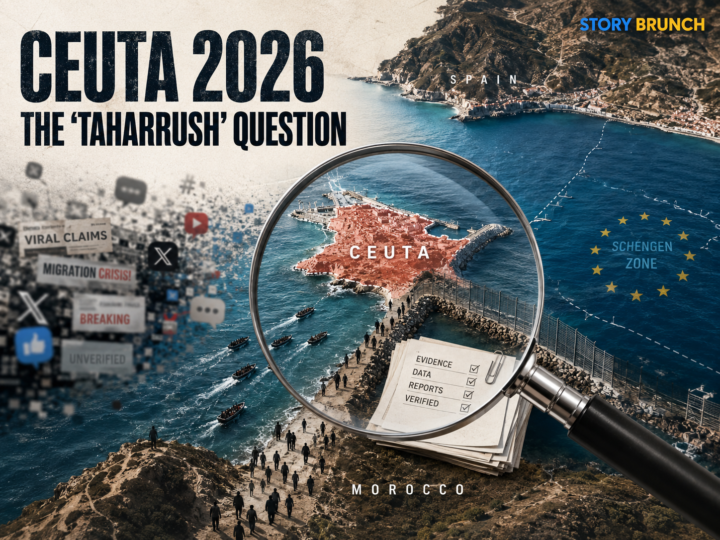
On the night of 30 July 2026, the fence and breakwaters that separate Morocco from the Spanish city of Ceuta stopped functioning as a border. Encouraged by rumours spreading on social media and a sudden slackening of Moroccan patrols, thousands of people waded and swam around the seawalls at Tarajal or clambered over the barrier. Within seventy-two hours, Spain’s interior ministry counted about 72,000 arrivals into a city of roughly 85,000. Ceuta’s regional president declared an “absolute humanitarian and social emergency” and asked Madrid for troops. By early August the death toll had climbed past eighty, most from drowning or the crush at the breakwater.
What followed was not one story but three tangled together: a humanitarian collapse, a diplomatic rupture inside the European Union, and — almost immediately — the return of a decade-old argument about sexual violence, migration and the Arab-Muslim world, carried under a single loaded word: taharrush. Untangling them is the whole task here.
What actually happened in Ceuta in late July 2026?
The proximate trigger was legal, not chaotic. In early July, Spain’s Supreme Court ruled that migrants intercepted at sea while trying to reach Ceuta or Melilla could no longer be summarily returned to Morocco. That ruling, amplified by online calls to gather at the Moroccan town of Fnideq, coincided with Moroccan security forces easing their grip on the frontier — the same lever Rabat pulled in May 2021, when roughly 8,000 people crossed during a diplomatic quarrel with Madrid.
The backdrop is Western Sahara. Morocco has long used migration pressure at Ceuta and Melilla as leverage in its dispute with Spain and Algeria over the territory, where the Polisario Front seeks independence. Whether or not Rabat orchestrated the July surge, its border management is inseparable from that geopolitics.
The scale was unprecedented for the enclave, yet the aftermath was fast. Spain said that of the roughly 72,000 who entered, about 70,000 returned to Morocco within days; an EU commissioner stated that essentially none reached the European mainland. What remained was a stranded population of a few thousand — including, by the youth ministry’s count, more than 1,300 children, many unaccompanied, in a city with formal reception capacity for fewer than 100.
Why did the crisis split the European Union?
Within a day, Italy turned a border emergency in North Africa into a Schengen dispute. On 31 July, Prime Minister Giorgia Meloni’s government suspended free movement with Spain, imposing “targeted and selective” checks on non-EU travellers arriving by air and sea, citing national security and the risk of secondary movements. Spain’s government reacted furiously: Foreign Minister José Manuel Albares summoned the Italian ambassador, and Prime Minister Pedro Sánchez retorted that solidarity may be optional but respect for the treaties is not, pointing to Frontex data showing Italy had recorded more irregular entries than Spain in recent years. By 8–9 August, Madrid had imposed reciprocal checks on arrivals from Italy, in force into September.
Brussels tried to hold the centre. Commission President Ursula von der Leyen called the scenes in Ceuta “unacceptable,” assigned two commissioners to the response, and insisted dangerous crossings must stop and returns be swift. An extraordinary videoconference of EU interior ministers, requested by Sánchez and backed by 22 states, produced expressions of “strong solidarity” and a pledge to build better early-warning systems. Domestically, the plan to transfer stranded minors to the mainland became a flashpoint: Sánchez’s government approved €25 million to support unaccompanied children, and the hard-right Vox party opposed spending on them at all.
Ceuta is where three fault lines meet at once: Europe’s border governance, Spain’s relationship with Morocco, and the continent’s unresolved argument about migration itself.
What is the sexual-violence dimension of the Ceuta crisis?
This is where care matters most, because it is the part most quickly distorted. The gravest documented harm in Ceuta has fallen on the arrivals themselves — above all on children left sleeping rough after reception centres were overwhelmed many times over.
What is on the record so far
- Ceuta University Hospital has treated at least five girls under 14, and reportedly a boy, for injuries consistent with sexual assault; medical staff say more than a dozen people presented with such injuries.
- Prosecutors opened preliminary proceedings in at least two cases; police are investigating up to six alleged assaults tied to the 30–31 July arrivals. As of early August, no arrests had been reported.
- The victims are overwhelmingly migrant minors who crossed during the surge and were left unsheltered — not local residents. Assaults are reported in makeshift settlements and the hills where minors slept.
- Spain’s Ministry of Equality warned of an “extreme risk” of sexual violence to stranded children; a football pitch was converted into a guarded sleeping area for women and girls, and police were seen escorting women through the enclave.
The context that produced this is a protection vacuum: an enclave with capacity for roughly 90 people absorbing thousands, minors on the streets, emergency services unable even to screen new arrivals. That is a child-protection and anti-trafficking failure — grim, real, and structurally distinct from the phenomenon the word “taharrush” usually names. A caution worth stating plainly: these figures are preliminary, the allegations are unproven and under investigation, and coverage spans outlets from careful Spanish dailies to partisan sites using “invasion” language. Hold the specifics loosely; hold the pattern — vulnerable children, no shelter, no arrests — seriously.
What is ‘taharrush,’ and where does the term come from?
Taharrush is simply the Arabic word for harassment. The version that entered European headlines — taharrush gamea, “group harassment” — describes a specific horror: a woman in a crowd encircled by men, an inner ring assaulting her while outer rings block would-be rescuers, some attackers posing as helpers to deepen the confusion.
Its documented modern history runs through Egypt. Reports of mobs assaulting women appeared around Cairo protests from 2005; in 2011 the American correspondent Lara Logan was assaulted by a crowd in Tahrir Square while covering the fall of Hosni Mubarak; and in 2013 rights groups documented dozens of mob assaults on women during demonstrations. Egyptian activists organised patrols and rescue teams in response — a detail the “cultural practice” framing tends to omit.
The term crossed into Europe after New Year’s Eve 2015–16 in Cologne, where dozens — ultimately hundreds — of women reported being surrounded, robbed and sexually assaulted near the central station amid a crowd reportedly of more than a thousand men, with smaller incidents in Hamburg and Stuttgart. German federal police and a regional interior minister reached for taharrush gamea to describe it, explicitly linking Cologne to Egypt. That is the moment a local crime wave became a civilisational storyline.
Is mob sexual violence uniquely Arab or Muslim?
This is the real dividing line, and an honest piece has to give both cases their strongest form rather than a caricature.
The case that it is a distinct, imported pattern
Critics of large-scale migration argue that the collective, public, crowd-based form of assault is culturally patterned, that it surfaced in Europe alongside mass arrivals from the Middle East and North Africa, and that the Cologne perpetrator demographics were real, not invented. They contend that officials and media initially downplayed the attacks to avoid appearing anti-immigrant, and that the reflex to shout “Islamophobia” is used to shut down a conversation about integration, policing and the treatment of women. On this view, refusing to name a pattern is itself a failure to protect women.
The case that the framing is manufactured
A body of scholarship — including work out of Cardiff University and by researchers such as Júlia Garraio — argues that taharrush gamea was essentially built as a category after Cologne: police took an Arabic phrase for “group harassment,” garbled its pronunciation, and recast it as an Arab “modus operandi,” framing sexual violence as foreign to Europe. They note that mass and mob sexual violence occur across cultures — at Western festivals, in stadiums, in war — and warn that the “civilisational” frame launders collective guilt onto Muslims and migrants while distracting from gender-based violence as a structural problem. Feminist writers describe being trapped between condemning real assaults and refusing their racist instrumentalisation.
Both cases carry partial truth, and pretending otherwise is how this debate curdles. The Cologne assaults happened; the perpetrator profile was not a fabrication; women were failed. And the leap from those facts to a coherent, exportable “Arab rape game” overreaches the evidence and has been politically weaponised. The defensible position is unglamorous: name the crimes, prosecute them, protect the victims, resist collective guilt, and don’t let a contested neologism do your analysis for you.
So how should we read the link between the Ceuta influx and ‘taharrush’?
Carefully, and in both directions. A surge of tens of thousands of people, overwhelmingly young men, into a small European city inevitably reignites the migration–security–integration debate. That is legitimate to report and to argue about.
But the specific “taharrush” storyline now attached to Ceuta — migrants importing the mob assault of local women — is not what the Ceuta evidence shows. The documented sexual violence there is predation on stranded migrant children inside the crisis, in a collapsed protection system. Conflating that with Cologne produces a false narrative on two sides at once: it lets restrictionists claim a “taharrush invasion” the facts don’t support, and it tempts others to wave away very real, very serious crimes against children because the wrong people are shouting about them. Ceuta is not proof of an imported rape culture; nor is it a story that can be filed under “nothing to see here.” It is a child-protection catastrophe, an EU governance failure, and a border being used as a geopolitical lever — three things that are quite bad enough without the myth.
What happens next?
The immediate emergency has ebbed — most who crossed have returned to Morocco, and Brussels insists no one reached the mainland. What lingers is harder: a few thousand people, including well over a thousand children, whose transfer to mainland Spain is now a partisan battle; a Schengen tit-for-tat between Rome and Madrid running into September; an EU promising early-warning systems it has promised before; and a Moroccan government that still holds the frontier as leverage over Western Sahara. Ceuta’s fence has been rebuilt many times. The politics that make it porous have not been.
Ceuta 2026: quick questions
How many people crossed into Ceuta, and how many died?
Spain’s interior ministry counted about 72,000 arrivals over roughly 72 hours from 30 July 2026; Ceuta’s authorities estimated up to 80,000. Around 70,000 returned to Morocco within days. The death toll, revised upward as the crisis unfolded, passed 80 — mostly drownings and injuries at the Tarajal breakwater.
Did the Ceuta crossing cause a “taharrush”-style mass assault on local women?
No — not on the evidence available. The documented sexual-assault cases in Ceuta overwhelmingly involve migrant minors as victims, assaulted while stranded without shelter. That is a protection and trafficking failure, which is different from the public, crowd-based “taharrush” pattern associated with Cologne 2016.
What does “taharrush” actually mean?
It is the Arabic word for harassment. “Taharrush gamea” means “group harassment” and describes a crowd encircling and assaulting a woman. The term entered European debate after the 2016 Cologne assaults; scholars dispute how accurately German authorities applied it.
Why did Italy suspend Schengen with Spain?
Italy’s government reintroduced temporary checks on non-EU travellers arriving from Spain on 31 July 2026, citing national security and secondary-movement risk after the Ceuta surge. Spain called it a breach of solidarity and imposed reciprocal checks in August.
Is mob sexual violence unique to Arab or Muslim societies?
There is genuine dispute. Some argue the collective public form is culturally patterned and arrived with MENA migration; researchers counter that mass sexual violence occurs across cultures and that the “taharrush” label was retrofitted to frame it as foreign. The crimes are real; the civilisational framing is contested.
A crowd can conceal a rescuer as easily as a predator, and a headline can bury a child as easily as a fact. Count carefully before you name the monster — and count the victims first.
Story Brunch · Curiosity Is CapitalEditor’s note. Figures reflect reporting available as of 11 August 2026 and may be revised; sexual-assault cases described here are alleged and under investigation, with no arrests confirmed at publication. This piece deliberately distinguishes documented facts from contested framing. If you or someone you know has been affected by sexual violence, contact local support services.