Which Cognitive Bias Secretly Runs Your Life?

The short answer
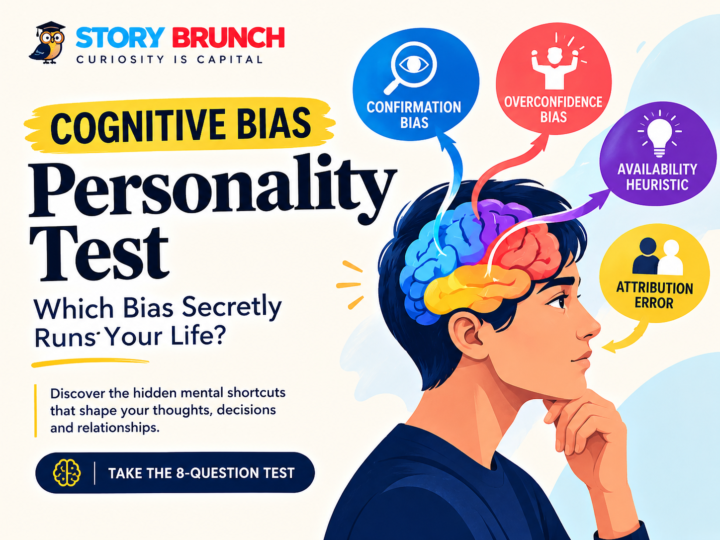
A cognitive bias is a predictable shortcut your mind takes that quietly bends your judgment. You can’t switch them off — but most people run one dominant pattern more than the rest. This test sorts you into one of four: the True Believer (confirmation), the Optimist’s Gambit (overconfidence), the Storyteller (availability), or the Just-World Juror (attribution). Answer honestly — the point isn’t to win, it’s to spot your own.
You are not as objective as you feel. Nobody is. The mind runs on shortcuts — fast, useful, mostly invisible — and those shortcuts have a house style. One person reliably sees what confirms them; another reliably overrates their own competence; a third mistakes a vivid story for a statistic; a fourth reads every outcome as a verdict on someone’s character.
None of these makes you foolish. They make you human, and specifically this kind of human. Knowing which one is yours doesn’t cure it — but it installs a warning light, and a warning light you can see is most of the battle. Eight questions. Pick the answer closest to your honest first instinct, not the one that sounds wisest.
A buzzy startup you admired just collapsed. Your gut reaction:
You’re guessing how long it’ll take to repaint a room. You say:
A stranger is confidently explaining something at a party. You tend to:
You saw a rare danger in the news and now you’re worried. You:
A friend just succeeded at something big. You instinctively credit:
When you’re clearly proven wrong, you most often:
You meet someone attractive and well-dressed. You quietly assume they’re also:
Your theory of how the world works mostly comes from:
Your dominant bias
—
From the book
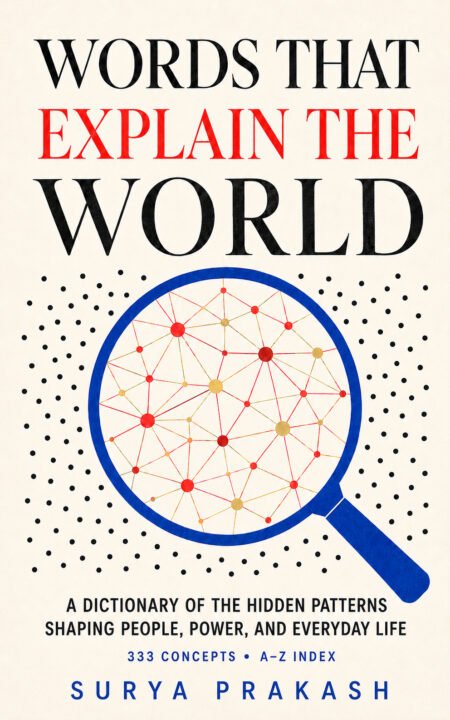
Words That Explain the World
“There is a name for what you’re noticing.”
Your dominant bias is one of thirteen named in a single chapter — The Ways Your Own Mind Fools You — inside a dictionary of 333 concepts that quietly shape people, power, and everyday life. Once you have the names, you can’t unsee them.
Get the book on Amazon →FAQ. Before you argue with your result
Can you have more than one dominant bias?
Absolutely — everyone runs all four to some degree. The test just surfaces the one you leaned on most across eight scenarios. A close second is common and worth reading too; think of the result as your loudest bias, not your only one.
If I know my bias, does it go away?
No — and that’s the honest part. You can’t debug the mind the way you patch software. What naming a bias does is slower and more useful: it installs a warning light. You start noticing the specific moment the shortcut fires, which is exactly when you get a choice you didn’t have before.
What’s the difference between confirmation bias and motivated reasoning?
Confirmation bias is what you notice — you register the evidence that agrees with you and skim past the rest. Motivated reasoning is what you do with it — your mind argues like a lawyer defending a conclusion it already reached, not a scientist testing one. The True Believer type runs both.
Is the availability heuristic always bad?
Not at all. Judging risk by what comes easily to mind is fast and often right. It only misfires when the vivid and the frequent come apart — plane crashes feel likelier than car crashes because they’re memorable, not because they’re common. The Storyteller’s job is to ask “is this common, or just unforgettable?”
Where do these four types come from?
They’re clusters of well-documented biases from cognitive psychology, grouped into four recognizable “operating systems”: confirmation and motivated reasoning; overconfidence and the planning fallacy; the availability heuristic and survivorship bias; and the fundamental attribution error, the just-world fallacy, and the halo effect. Each is unpacked, with its own name, in the book this test comes from.
You cannot delete the shortcut. But once it has a name, you can see it take the wheel — and that half-second of seeing is where your freedom lives.— Story Brunch · The Test