Googling Is Over: How a Generation Searches Now

Internet & Culture · Cultural Decode
Googling Is Over: How a Generation Searches Now
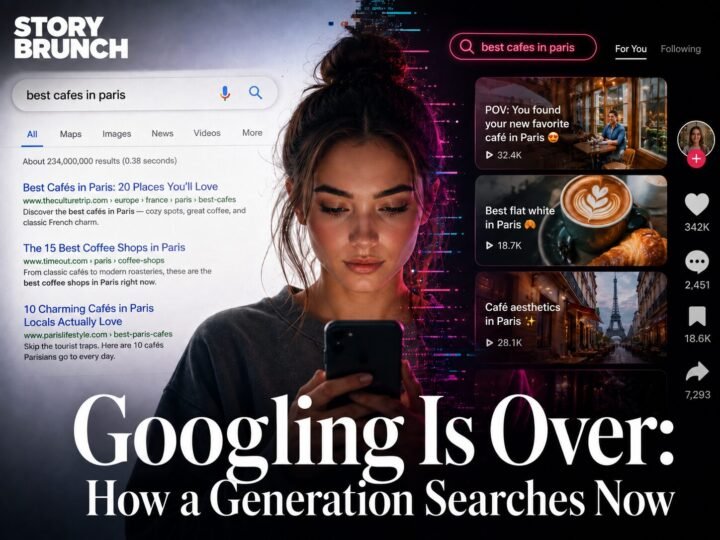
Ask a search bar, or ask a stranger’s face on a vertical screen? A generation already answered that question and didn’t notice it was a question.
FIG. 0 — THE RESULT ON THE LEFT IS FAKE. THE HABIT OF NOT WANTING IT ANYMORE ISN’T. KEEP SCROLLING.
Part I · The Habit
You already stopped Googling half your questions. You just didn’t notice the switch.
Think about the last ten things you actually needed to find out. A lunch spot. Whether a product is worth the price. How to fix the thing under the sink. What a rash on your arm might be. Whether that outfit works. What’s actually happening in a breaking news story, right now, before the articles catch up. A few years ago, every single one of those went through the same box: a white page, a blinking cursor, a list of blue links. Go back through your own last ten and be honest about how many of them actually did.
For a fast-growing share of them, you probably searched inside an app that was never built to be a search engine at all. You typed “best ramen” into TikTok instead of Maps. You added the word “reddit” to the end of a Google query specifically to filter out everything Google would otherwise show you first. You asked a chatbot directly and took the paragraph it gave you without opening a single one of the sources it based that paragraph on. None of this felt like a decision. It felt like just, obviously, what you do now — which is exactly how you know something underneath it actually changed.
The stat everyone half-remembers, corrected
In July 2022, Google’s own senior vice president overseeing Search, Prabhakar Raghavan, told an audience at Fortune’s Brainstorm Tech conference that the company’s internal research showed something close to 40% of young people don’t open Google Maps or Search when they’re deciding where to get lunch — they open TikTok or Instagram instead. It is worth being precise about what that sentence actually claimed, because the press mangled it almost immediately: the underlying study covered U.S. users aged 18 to 24 specifically, it was about restaurant recommendations specifically, and “something like almost 40%” turned into “nearly half” turned into “Gen Z has abandoned Google” within about a news cycle. Google itself never published the underlying numbers.
The correction matters, and so does what survived the correction: the direction was real, and it kept moving. A 2025 Adobe Express survey of more than 800 U.S. consumers found that roughly one in two now describe TikTok as a search engine they actually use, and a quarter of Gen Z respondents specifically called it an effective alternative to a traditional one. Three years after a single, over-quoted conference soundbite, the behavior it was describing had gone from “an internal Google study about lunch” to “half the country, about everything.”
The short answer, before the long one
Social search is the now-mainstream habit of using a social or video platform — TikTok, Instagram, YouTube, increasingly an AI chatbot — as a primary discovery tool, in place of a traditional search engine’s list of ranked links. It is distinct from but closely related to zero-click search: a search that ends with the user’s question answered directly inside the results page or chat window, with no click to any outside website at all. In 2026, industry researchers including SparkToro estimate that fewer than one in three Google searches in the U.S. still send a click anywhere, a figure that was roughly one in two as recently as 2019.
Neither trend means people stopped searching. They mean the destination changed — from an index of the open web to a small number of platforms that answer, or show, the thing directly and would rather you never left.
Part II · The Machine
Why the switch flipped now, not ten years ago
Google didn’t get worse in a single afternoon, and TikTok didn’t become a search engine on purpose. Four separate shifts converged on the same result: an answer that arrives without a click. Each one is individually a reasonable response to something real. Together, they add up to the end of the blue link as the default unit of finding things out.
Engine 1 — Trust migrated from authority to authenticity
A page that ranks first on Google earned that position, in large part, by being optimized for Google: the right keyword density, the right backlink profile, the right “10 Best” structure. None of that is a signal of whether the writer actually ate the ramen. A stranger filming their own face while eating the ramen is a much weaker citation by any traditional standard — no peer review, no editorial process, no fact-check — and it is, for a huge number of people, now the more trusted source, precisely because it’s harder to fake convincingly than a paragraph is.
Engine 2 — The answer learned to skip the index
An index is a promise: ask a question, and we’ll point you to whoever answered it best. Google’s AI Overviews, and its newer, more conversational AI Mode, quietly break that promise in the user’s favor — the answer itself now sits on the results page, or inside a chat window, sourced from an index the user never has to visit. SparkToro estimates AI Overviews now appear on more than one in five Google searches, and cutting click-through by roughly 60% when they do. A Pew Research Center analysis of real search sessions found that only 8% of users click an external link when an AI Overview is present, versus 15% when it isn’t — and that a quarter of AI-Overview searches end the entire session with no further click of any kind, well above the rate for ordinary searches.
Engine 3 — The feed started asking first
A search box waits for you to type a question. A recommendation feed skips that step: it has already guessed the question from what you lingered on yesterday, and it answers before you consciously formed the query. This is a different kind of “search” entirely — not retrieval on demand, but discovery that arrives pre-emptively, tuned to a profile of you that gets more accurate the longer you scroll. Increasingly, the first time you learn you wanted to know something is the moment the feed already tells you.
Engine 4 — Video got cheaper to fake-proof than text got trustworthy
Producing a passable 800-word SEO article got radically cheaper over the last three years, right as trust in 800-word SEO articles collapsed for the same reason. A 30-second video of a real person doing a real thing is, for now, still comparatively expensive to convincingly fabricate — which makes it the format that currently absorbs the trust text used to hold. That gap will close. It just hasn’t fully closed yet, and platforms built around video inherited the trust that text lost in the meantime.
The blue link was never the point. It was just the only available format for “I’ll show you, rather than tell you” — right up until video got cheap enough to replace it.
Part III · The Evidence
Nine questions, and where they actually get answered now
Same information need, different destination. Toggle each card between the search you’d have run in 2015 and the one you probably ran last week.
01 · Lunch, Right Now
Engine: AuthenticityA ranked listicle is one click and one editorial voice. A video is someone’s actual face, actually chewing, in real time — a harder signal to fake, and for most people now, a more trusted one.
02 · Is It Worth The Price
Engine: AuthenticityAffiliate-link reviews are structurally motivated to say yes. A stack of unrelated strangers’ videos, most with nothing to sell, functions as an informal, un-curated jury.
03 · Fixing Something
Engine: Video > TextA forum thread describes what a wrench looks like turning. A 47-second clip just shows the wrench turning — for a physical, visual task, the format gap was always there. Video finally got cheap enough to close it.
04 · Skincare Routine
Engine: The Feed Asks FirstNobody typed “skincare routine” — the feed served three, back to back, before anyone searched anything, tuned to a face it has been quietly studying for months.
05 · Trip Planning
Engine: AuthenticityEvery “hidden gem” reel is, definitionally, the same gem 214 other accounts already found — but it still reads as more personal than a listicle with the same ten stops.
06 · Breaking News
Engine: The Answer Skips The IndexA live caption from someone’s phone at the scene beats a wire-service article by the time it takes an editor to file it — even when the caption is wrong and the article isn’t.
07 · “Is This Normal”
Engine: AuthenticityA stranger describing the exact same thing happening to their own body reads as diagnosis-adjacent proof. It isn’t one. That gap is exactly where this format is riskiest.
08 · Relationship Advice
Engine: AuthenticityA 212-reply forum thread took a week to build consensus. A single confident 30-second verdict now arrives in one sitting — with a fraction of the disagreement, which is a feature for anxiety and a bug for accuracy.
09 · Quick Fact Lookup
Engine: The Answer Skips The IndexThe purest zero-click case: nobody needs a website to know what 15 dollars is in rupees. The index was never the point of this query — it was always just the fastest available calculator.
Method note: fake, generic mockups illustrating a documented behavioral pattern — no real site, brand, or creator is depicted or implied.
Part IV · The Complication
The open web being mourned here was not exactly Eden
The honest version of this argument has to admit something the nostalgia version skips: by the time TikTok search became a headline, Google search had already spent years visibly rotting from the inside, and plenty of people had noticed well before any of them owned a ring light.
“Add reddit to your Google search” became a widely repeated piece of folk wisdom for a specific reason: years of keyword-stuffed, ad-stacked, algorithmically-optimized-for-Google-not-humans content had made the front page of results for almost any “best” query feel interchangeable, sponsor-shaped, and thin. Independent researchers and working SEO practitioners spent the early 2020s documenting the same complaint from different angles — a search results page increasingly dominated by content engineered to rank rather than to help. The open web that social search is supposedly killing had, in a meaningful sense, already been substantially captured by an earlier, less visible optimization economy. What’s dying now is not a pristine library. It’s a library that had already been quietly restocked with content-farm paperbacks.
The index wasn’t neutral before feeds replaced it. It was just optimized for a different, quieter audience: the crawler, not the reader.
What actually improves, not just changes
Video and social search close a real gap that ten years of text-based SEO never did: some knowledge is inherently visual or physical, and was always poorly served by a wall of text pretending otherwise. A repair, a dance step, a cooking technique, an outfit’s actual drape on an actual body — these were never well-served by 800 keyword-optimized words, and a short video answers them in a way no listicle ever could. Discovery through an authentic voice also lowers a real, unfair barrier: a genuine home cook or an actual patient describing a real experience never had a path to outrank a content farm’s SEO budget in classic search. On a feed built for engagement rather than backlinks, they sometimes can.
There’s a colder, more numbers-driven upside too. Even as overall click volume falls, the traffic that does arrive from AI answers and social platforms tends to convert at a noticeably higher rate per visit than old-fashioned organic search traffic — several independent industry analyses in 2025 put AI-referred visitors anywhere from roughly two to nine times more likely to convert. Less traffic, arriving more interested, isn’t nothing. It just isn’t the same business the open web used to run.
Part V · What Quietly Dies
The commons was the part nobody remembered to defend
Here is the part of the argument the debate usually skips, because it isn’t about whether TikTok search is good or bad for any one query. It’s about what a search engine actually was, structurally, that a feed structurally cannot be.
An index only works as a commons if it can see everything and everyone can see it back: any site can, in principle, be crawled, ranked and linked to by anyone else, and any reader can click through to the actual original source and verify it themselves. A platform’s internal search has none of that by design. TikTok’s index isn’t crawlable by Google. A creator’s caption isn’t a citation anyone else can verify or archive the way a hyperlink was. An AI chatbot’s answer, synthesized from sources the user never sees and often can’t retrace, replaces “here’s where I found this” with “trust me.” The open web’s actual innovation — one interlinked, mutually verifiable, anyone-can-check-anyone graph of pages — is being quietly replaced by several private, sealed, non-interoperating answer boxes that don’t talk to each other and were never designed to.
The hyperlink itself is disappearing at a measurable rate, with or without any help from social search. A Pew Research Center analysis published in 2024 found that a quarter of all webpages that existed at any point between 2013 and 2023 are no longer reachable at all — a figure that climbs to 38% for pages specifically from 2013, against just 8% for pages from 2023. More than half of Wikipedia’s citation links now point at something that no longer exists. A widely cited Harvard Law Review study found that roughly 70% of links inside law journal articles, and about half the URLs cited in actual U.S. Supreme Court opinions, no longer contain the material they were cited for. One analysis of “deep links” — a URL to a specific article, rather than a homepage — put their median lifespan at about 1.3 years. The footnote of the internet is dissolving faster than the internet itself.
A hyperlink was a small, radical promise: you don’t have to take my word for it. A caption is not that promise. An AI Overview’s citation you never click is not that promise, either.
The business consequences of all this stopped being theoretical during 2025. Chegg, the education-content company, reported a 49% year-over-year decline in non-subscriber traffic between January 2024 and January 2025, and filed an antitrust complaint against Google that February arguing AI Overviews were answering homework questions using content trained substantially on Chegg’s own material — without sending Chegg any of the traffic that used to fund making that material. Penske Media Corporation, publisher of Rolling Stone and Billboard among others, filed a similar antitrust suit against Google in September 2025, alleging the same basic asymmetry at a larger scale: AI Overviews built from publisher journalism, competing directly against the publishers who wrote it, for free, without consent. Reporting through 2025 put HubSpot’s organic traffic decline in the 70–80% range, one of the most frequently cited casualties of the shift industry-wide. Ahrefs coined a clean name for the underlying pattern showing up across almost every publisher’s own analytics dashboard: the Great Decoupling — impressions climbing, clicks falling, visibility and traffic no longer meaning the same thing.
There’s a closing irony underneath all of it worth sitting with. The AI systems now answering questions instead of sending a click to the open web were trained, in the first place, on an archive of that same open web — the very pages, forums and articles now losing the traffic that used to justify writing more of them. The commons is being consulted less and depleted just the same, read by fewer humans and by more machines, cited by neither.
A necessary disclosureThis article is formatted with H2s and an FAQ schema for a search engine, a pull-quote sized for a screenshot, and a two-sentence answer up top for whichever chatbot you asked instead of reading this far. We are not above the thing being described here. Nobody publishing on the internet in 2026 is — including, especially, us.
Questions this piece gets asked
What does “social search” actually mean?
Social search is the practice of using a social media or video platform — TikTok, Instagram, YouTube, and increasingly an AI chatbot — as a primary tool for finding information, in place of a traditional search engine. It has grown fastest for recommendation-style queries: restaurants, product reviews, style inspiration, and how-to content, where a first-person video reads as more trustworthy than a written result.
Is it true that 40% of Gen Z use TikTok instead of Google?
The precise, original claim, made by a Google senior vice president in 2022, was narrower: internal research suggested close to 40% of U.S. users aged 18–24 use TikTok or Instagram rather than Google Maps or Search specifically when deciding where to eat. Media coverage widely rounded this up to “nearly half” and generalized it to all search. More recent, broader consumer surveys suggest the underlying trend has since grown well past that original, narrower finding.
What is a “zero-click search”?
A zero-click search is a search query that gets answered directly within the search results page or an AI chat interface, without the user clicking through to any external website. Industry researchers including SparkToro estimate that fewer than one in three Google searches in the U.S. now result in a click anywhere, with the rate roughly doubling when an AI Overview is present.
Why is Google adding AI Overviews to search results?
AI Overviews and the more conversational AI Mode are Google’s response to users increasingly wanting a direct answer rather than a list of links to evaluate themselves, and to competitive pressure from AI chatbots and social platforms capturing search-like behavior. Google has reported AI Mode alone surpassed one billion monthly users, with query volume more than doubling each quarter.
What is “link rot” and why does it matter?
Link rot is the gradual disappearance of previously accessible webpages and hyperlinks. A 2024 Pew Research Center study found a quarter of all webpages existing between 2013 and 2023 are no longer reachable, and that more than half of Wikipedia’s citation links are broken. It matters because the hyperlink was the mechanism that let anyone verify a claim’s original source — as pages vanish, that verification trail disappears with them.
What is GEO (Generative Engine Optimization)?
GEO, sometimes called AEO (Answer Engine Optimization), is the emerging discipline of optimizing content to be cited or summarized inside AI-generated answers — on Google’s AI Overviews, in ChatGPT, or in Perplexity — rather than optimizing purely to rank in a traditional list of blue links. It has emerged as classic SEO’s influence over actual traffic has declined even as it remains necessary groundwork for AI citation.
Sources & further reading
- Raghavan, P., remarks at Fortune Brainstorm Tech (July 2022), and subsequent reporting/correction by Econsultancy, NBC News and Fortune.
- SparkToro, “In 2026, Less Than One Third of Google Searches Still Send a Click” (2026); Search Engine Land coverage of the same study.
- Pew Research Center, analysis of AI Overview click behavior (2025); Pew Research Center, “When Online Content Disappears” (May 2024).
- Reporting on Chegg’s February 2025 and Penske Media’s September 2025 antitrust suits against Google, via Search Engine Journal and industry trade press.
- Ahrefs, reporting on “the Great Decoupling” of search impressions and clicks (2025–2026).
- Adobe Express consumer survey on TikTok as a search tool, as reported by BGR (2026).
Related on Story Brunch