The Museum of Dead Platforms

Internet & Culture · Permanent Collection
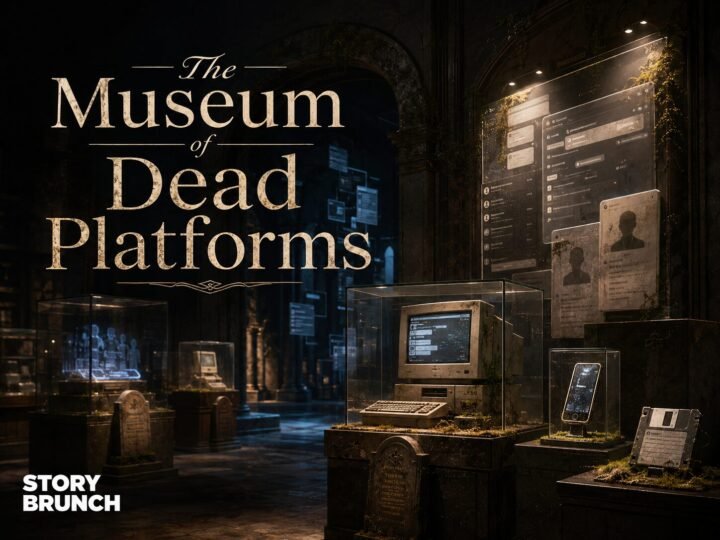
The Museum of Dead Platforms
Twenty-three graves. Six causes of death. Thirty years of places you used to live. Please keep your voice down — some of these are still technically online.
OPEN 24/7 · ADMISSION FREE · FLASH PHOTOGRAPHY ENCOURAGED
23Graves
6Causes of Death
2Zombies
2Resurrections
1Reincarnation
You had a profile somewhere in here. Maybe it was a GeoCities page with a construction-worker GIF and a visitor counter stuck at 00047. Maybe it was the agonized weekly politics of a MySpace Top 8, or an AIM away message calibrated to be read by exactly one person. If you grew up in India or Brazil, it was almost certainly Orkut — the scraps, the testimonials your friends wrote like tiny eulogies for the living, the little counter telling you who had visited your profile, which felt, briefly, like the most important technology ever invented. You spent real years in these places. You made friends, made enemies, fell in love, got dumped in a status update. And then one day — sometimes with a farewell letter, more often with a redirect — the place where all of that happened simply stopped existing.
The internet does not have an old town. It has a mass grave, and almost nobody visits, because the graves have no markers — a dead platform’s URL just returns someone else’s landing page. This museum is an attempt to put the markers up. Twenty-three platforms, each with a headstone, a cause of death, and a proper record of what it invented before it went. Because here is the thing the eulogies always miss: almost nothing in here died of bad ideas. They died of specific, diagnosable, repeatable causes — and the platforms you live on today are not immune to a single one of them.
Placard at the entrance
Social platforms die constantly and predictably. The graves below hold services that together once counted well over a billion registered users: GeoCities (once the third-most-visited site on the web), MySpace (once the biggest site in America), Orkut (once the dominant social network of both India and Brazil), Vine (200 million actives at its peak), Skype (once so universal its name was a verb). Google alone has shut down so many products that a dedicated memorial site, Killed by Google, tracks the count in the hundreds.
The causes of death cluster into six types: corporate euthanasia (a healthy-enough product shut by its owner), outcompetition, self-inflicted wounds (fatal redesigns and pivots), hype collapse, moderation toll (death by the cost of policing content), and absorption (merged into a successor). The pattern-recognition is the point of the exhibit: every cause on this list is currently operating on a platform you use today.
Gallery I · Pathology
The six causes of death
Corporate euthanasia fills more graves than everything else combined — twelve of our twenty-three. This is the death that confuses civilians most: the platform wasn’t failing, exactly; it just wasn’t succeeding enough for an owner with bigger priorities. Google Reader had a devoted global user base the day it died. Vine had cultural influence out of all proportion to its size. AIM, ICQ, MSN Messenger, and Skype were each, in their day, the world’s default way to talk — and each was walked behind the barn by a parent company that had already built or bought the replacement. The lesson etched over this wing: on someone else’s platform, you are not the customer of the place you live. You are a line item in a strategy that can change.
Outcompetition is the death everyone expects and the second-rarest here — MySpace to Facebook, Bebo to both, Meerkat to Periscope (killed in months by a rival with better distribution), StumbleUpon to the infinite feeds that made a “stumble” button redundant. Self-inflicted wounds get their own wing because of Digg, which in 2010 shipped a redesign so despised that its community decamped to Reddit essentially over a weekend — the canonical proof that you can murder a beloved product with a single deploy — and Friendster, which had the idea first and lost everything to pages that took twenty seconds to load. Hype collapse claims the platforms that were invitations before they were products: Google Wave and Clubhouse, both of which discovered that artificial scarcity generates lines, not love. Moderation toll is the newest pathology — Omegle’s founder shut the site in 2023 with a letter saying the fight against its abuse could no longer be sustained financially or psychologically; Yik Yak’s anonymous local feeds made it a harassment machine schools raced to ban. And absorption is barely death at all: Musical.ly’s grave is empty, because Musical.ly is walking around wearing the name TikTok.
Almost nothing in here died of bad ideas. It died of ownership, competition, redesigns, hype, moderation math — causes still operating on every platform you use today.
Gallery II · The Grounds
The graveyard
Twenty-three headstones, arranged by year of burial. Filter by cause of death, then click any stone to read its full record on the placard below. Badges mark the special cases: the zombies, the resurrected, and the one reincarnation.
Showing 23 of 23 graves
✝
GeoCities
1994 – 2009
Under construction, forever.
✝
Google Wave
2009 – 2012
You had to be invited.
Resurrected ’25
✝
Digg
2004 – 2012
Buried by its own redesign.
✝
MSN Messenger
1999 – 2013
Appears offline.
✝
Google Reader
2005 – 2013
Marked all as read.
✝
Orkut
2004 – 2014
No new scraps.
✝
Friendster
2002 – 2015
Loading…
✝
Meerkat
2015 – 2016
Streamed first. Died first.
✝
Vine
2013 – 2017
Do it for the —
✝
AIM
1997 – 2017
Away message, permanent.
Resurrected ’21
✝
Yik Yak
2013 – 2017
Rose from this plot. Twice shy.
✝
Club Penguin
2005 – 2017
Waddle on.
✝
StumbleUpon
2002 – 2018
Stumbled. Fell.
Reincarnated
✝
Musical.ly
2014 – 2018
Not dead. Wearing a new face.
✝
Bebo
2005 – 2019
$850,000,000 → $1,000,000.
✝
Google+
2011 – 2019
You were auto-enrolled in this grave.
Zombie
✝
MySpace
2003 – undead
Tom was your first friend.
✝
Periscope
2015 – 2021
The broadcast has ended.
✝
Yahoo Answers
2005 – 2021
This question has been deleted.
Zombie
✝
Clubhouse
2020 – fading
The room is still open. Hello?
✝
Omegle
2009 – 2023
You have disconnected.
✝
ICQ
1996 – 2024
Uh-oh.
✝
Skype
2003 – 2025
The call has ended.
Open a record
Click any headstone — or use the Previous / Next buttons — to read that platform’s full record: born, died, peak, cause of death, what it invented, and how it went.
Gallery III · Special Collections
The zombies, the resurrected, and the reincarnated
Not every grave in this museum holds a body. Walk the special wings and the neat line between alive and dead starts to blur — which turns out to be the most instructive part of the tour.
The zombie wing holds platforms that are technically online and culturally deceased. MySpace still resolves; you can visit it right now, the way you can visit a mall that lost its anchor stores. Its most honest moment as a zombie came in 2019, when a botched server migration destroyed twelve years of user uploads — a loss reported at around 50 million songs from 14 million artists, an entire era of independent music, gone in a maintenance window. Clubhouse, likewise, still opens; the rooms are just quieter now, a lesson in the difference between shutting down and fading out. Zombies matter to the collection because they prove that a platform’s death is social, not technical. The servers were never the point. The people were the platform, and the people left.
The resurrection wing is small and strange. Yik Yak died in 2017 — harassment-plagued, banned from schools, valuation evaporated — and rose in 2021 under new owners, a rare second act for a dead brand. And in 2025, Digg itself was revived by its original founder Kevin Rose with Reddit co-founder Alexis Ohanian — the man whose site had absorbed Digg’s fleeing community fifteen years earlier now co-owner of the corpse. History does not repeat, but it clearly reads its own museum placards. The reincarnation wing holds a single, spectacular exhibit: Musical.ly, the lip-sync app that ByteDance bought for a reported ~$1 billion in 2017 and folded into TikTok the following year. Every clip on your For You page is, in a real sense, playing over that grave. The most successful platform of this decade is a dead platform wearing a new face — which should permanently complicate anyone’s confidence about what “dead” means in this industry.
What actually dies when a platform dies
The corporate announcement always says the same thing: users can download their data. Here is what the download never contains. When GeoCities closed, volunteer archivists at Archive Team raced Yahoo’s deletion schedule to save what they could of 38 million pages of early web life — the rest is gone, the largest demolition of amateur creative work in history to that point. When Yahoo Answers closed in 2021, sixteen years of questions and answers — a genuinely irreplaceable record of what ordinary people didn’t know and how other ordinary people explained it — went dark. The MySpace music wipe erased scenes, not files. And beyond the data there is the softer loss the export tool cannot touch: the social graph itself. Your Orkut testimonials were written about you, in a voice your friends only used there. Your Top 8 was a diplomatic document. An away message was a mood ring for an entire generation. None of that survives migration, because it wasn’t content. It was context — and context is the thing platforms cannot export, only destroy.
The servers were never the point. The people were the platform, and the people left.
Why they die: the network effect runs both ways
The economics underneath every stone in this yard is the same equation read in two directions. Network effects — each new user making the service more valuable to every other user — build platforms exponentially, which is why the winners feel invincible. But the same math governs the exit: each departing user makes the service slightly less worth staying for, which nudges out the next user, which nudges the next. Growth compounds, and so does abandonment; the difference is that abandonment has no marketing department. That’s why platform deaths look sudden from outside — MySpace to Facebook, Digg to Reddit in a weekend — when they were actually gradual, then instantaneous, like the Hemingway line about bankruptcy. Add the modern accelerant — the degradation cycle writer Cory Doctorow named “enshittification,” in which platforms squeeze users to please business customers and squeeze both to please shareholders — and you have the full pathology report: platforms die when the reason to stay decays faster than the cost of leaving. Every grave here is a place where, one ordinary day, that line was crossed and nobody announced it.
Visitor Information
Questions asked at the front desk
What happened to Vine?
Twitter bought Vine for a reported $30 million in 2012, before the app even launched, and shut it down in January 2017 despite roughly 200 million active users at its peak. Vine never found a way to pay its stars — who decamped to YouTube and Instagram — and Twitter, in financial trouble itself, wouldn’t fund the fight. Its six-second loop grammar became the DNA of TikTok, which is why Vine’s grave is the most-visited in the museum.
What happened to Orkut, and why was it so big in India and Brazil?
Orkut launched from Google in 2004 (a 20%-time project by engineer Orkut Büyükkökten) and, while it lost the US to Facebook, it became the dominant social network of Brazil and India — scraps, testimonials, and communities defined a generation’s internet in both countries. Google shut it down in September 2014 to consolidate social efforts behind Google+, which then died five years later: a double tragedy the museum displays side by side.
Is MySpace still alive?
Technically yes — the site still operates, which is why it hangs in the zombie wing rather than lying under a stone. Culturally it died around 2009–2011 as its users migrated to Facebook, and in 2019 a failed server migration destroyed twelve years of uploaded music and media — reported as some 50 million songs by 14 million artists — erasing much of what remained of its cultural archive.
Why does Google shut down so many products?
A mix of incentives: promotion culture that rewards launches over maintenance, consolidation pushes (Orkut and Reader were both cleared partly to make way for Google+), and the arithmetic of a trillion-dollar company, where a product with merely millions of devoted users rounds to zero. The pattern is prolific enough that a memorial site, Killed by Google, maintains the running list — it stands in the hundreds of products.
Why did Skype die?
Corporate euthanasia, textbook case. Microsoft bought Skype for $8.5 billion in 2011, let it stagnate through a decade of redesigns while Zoom ate video calling during the pandemic, and finally retired it in May 2025 in favor of Teams. Skype was once so universal its name was a verb — the museum notes that verbs, historically, are no protection.
Can a dead platform come back?
Rarely, but yes — the museum has a resurrection wing. Yik Yak returned in 2021 under new ownership after dying in 2017, and Digg was revived in 2025 by original founder Kevin Rose with Reddit co-founder Alexis Ohanian. The pattern in both: the brand survives death better than the community does. You can restart the software; the people who made the place a place are the hard part.
Acquisitions Ledger
Sources & further reading
- Killed by Google (killedbygoogle.com) — the running memorial of Google’s discontinued products.
- Archive Team & the Internet Archive — the GeoCities rescue effort and the ongoing preservation of shuttered platforms.
- Contemporary reporting on the MySpace 2019 data loss (~50M songs), the Vine shutdown, the Digg v4 exodus, the Bebo acquisition arc ($850M purchase, $1M buy-back), and Omegle founder Leif K-Brooks’s 2023 shutdown letter.
- Coverage of the 2025 Skype retirement (Microsoft → Teams) and the 2025 Digg revival by Kevin Rose and Alexis Ohanian.
- Doctorow, C. — the “enshittification” essays on platform decay.
Curator’s note: peak-user figures and acquisition prices are as reported in contemporary press coverage; platform economics are notoriously self-reported. Where numbers conflict in the record, the placards use the most commonly cited figure and round with humility. Corrections from former residents of any of these places are welcome — this museum considers memory a primary source.
Gift Shop
Related on Story Brunch