Tradwife vs. Girlboss: A Decade of Whiplash

Story Brunch Culture File – 2013 to 2026
Tradwife vs. Girlboss: A Decade of Whiplash
How internet womanhood swung from glass-ceiling ambition to sourdough submission, and why the real story is not the blazer or the apron. It is the price of trying to be free inside systems that still bill women twice.
2013Lean In turns ambition into a mass-market script
2014#GIRLBOSS packages startup feminism for the feed
77.4%Prime-age U.S. women’s labor-force participation in 2023
29%Women in C-suite roles in McKinsey‘s 2025 report
29%U.S. marriages where spouses earn about the same
The decade began with a woman in a conference room telling other women to pull their chairs closer to the table. It ended, or at least curdled into its strangest sequel, with women in linen dresses filming themselves making cereal from scratch while captions promised peace through domestic obedience.
At first glance, girlboss and tradwife look like cultural enemies. One is all inbox, pitch deck, equity, airport salad, founder lore. The other is raw milk, home birth, handwritten chore charts, soft voice, biblical femininity, and a kitchen washed in morning light. One says: become the boss. The other says: marry the provider. One worships self-optimization. The other worships self-renunciation.
But the deeper story is more uncomfortable: both are responses to the same exhausted bargain. Modern women were told they could be anything, then discovered that “anything” often meant working for pay, managing the home, performing wellness, absorbing backlash, staying desirable, and narrating the whole thing online. Girlboss culture sold ambition as liberation. Tradwife culture sells retreat as liberation. The whiplash is not random. It is what happens when feminism is asked to solve problems that wages, housing, childcare, healthcare, and men have quietly refused to solve.
The Short Answer
Tradwife vs. girlboss is not just a fight between homemaking and career ambition. It is a decade-long swing between two fantasies of control. The girlboss fantasy says a woman can beat patriarchy by winning harder inside capitalism. The tradwife fantasy says she can escape capitalism by returning to a protected home. Each captures a real longing: respect, rest, family, status, safety, usefulness, beauty, autonomy.
The catch is that both scripts can turn into cages when they become identities to perform. A job title cannot love you. An apron cannot protect you from financial dependence. The healthier third path is not “boss babe” or “submissive wife”; it is sovereignty with support: shared care, decent work, economic agency, chosen domestic life, chosen ambition, and the right to change your mind without losing your dignity.
Plate I – The Decade in Six Scenes
Click through the whiplash machine
The internet did not calmly update its gender politics. It swung. Each era arrived as a correction to the last one, then became its own performance trap.
Plate II – The Blazer
The girlboss was born from a real hunger
It is easy, in hindsight, to mock the girlboss: the mug that said “hustle,” the tote bag that said “CEO,” the inspirational Instagram quote floating over marble. But the archetype did not come from nowhere. It came from women looking at rooms where men still held the money, the titles, the term sheets, and the default assumption of competence.
Sheryl Sandberg‘s Lean In arrived in 2013 as a polished corporate sermon: sit at the table, negotiate, raise your hand, do not leave before you leave. It gave many professional women a language for the small daily ways they were taught to shrink themselves. It also carried the limits of its altitude. It spoke most fluently to women already close enough to the table to pull up a chair.1
Then Sophia Amoruso‘s #GIRLBOSS brought a scrappier myth: the thrift-store outsider who turned an eBay shop into the fashion company Nasty Gal. The appeal was electric because it fused two dreams that had rarely been sold together to young women: be desirable and difficult, stylish and in charge, self-made and unashamed.2
The girlboss did not say “abolish the hierarchy.” She said “let me climb it in better shoes.”
That was its power, and its weakness. The girlboss did not demand a new economy of care. It demanded that women become more fluent in the existing one. She was not the end of patriarchy; she was a woman with a better title inside it.
Plate III – The Invoice
Then the hustle bill came due
The girlboss era carried a hidden clause: if liberation came through overwork, then exhaustion could be rebranded as ambition. Startup feminism inherited startup culture’s appetite for speed, disruption, and a slightly theatrical contempt for limits. It encouraged women to outwork unfair systems while smiling as if the systems were inspirational challenges.
Then the icons wobbled. Nasty Gal filed for bankruptcy in 2016, and Amoruso‘s public story became less a fairy tale than a cautionary case about scaling, leadership, labor, and mythmaking.3 Other founder scandals followed across media, fashion, wellness, and tech. By the early 2020s, the girlboss had become less an aspiration than a meme: a woman who spoke empowerment while reproducing the same extraction she claimed to have escaped.
This backlash was not just envy. It was a moral audit. Younger audiences had watched “do what you love” become “work forever because your job is your identity.” They had watched elite feminism celebrate seats at the table while service workers, caregivers, mothers, disabled women, and women of color kept asking who was serving lunch.
Culture moved from ambition to suspicion. The new question was not “How do I become the boss?” It was “Why is the boss asking me to be grateful for burnout?”
Plate IV – The Apron
The tradwife entered through the kitchen camera
The tradwife did not arrive like a manifesto. She arrived like a recipe video. A clean counter. Butter melting. A baby on the hip. A dress that never seems to wrinkle. A caption about feminine peace. A husband described as provider, leader, protector. Sometimes the content is explicitly religious or political; sometimes it is simply beautiful domestic labor, filmed with the softness of a luxury perfume ad.
That softness matters. Online tradwife culture often markets itself as relief from modern chaos: no office politics, no dating apps, no anxious career ladder, no fluorescent exhaustion. It takes real frustrations – burnout, loneliness, expensive childcare, alienating work, spiritual hunger – and offers an emotionally coherent answer: come home.
But “come home” is not neutral when home is also a gendered workplace. The tradwife ideal can mean many things, from a voluntary stay-at-home partnership to a hard anti-feminist ideology. Researchers Sophia Sykes and Veronica Hopner describe tradwife influencers as blending domestic aesthetics, social media strategy, and right-wing ideology, while noting a spectrum from conservative homemaking to more extreme online spaces.4 The Guardian‘s 2024 coverage also emphasized that the trend is not a monolith: some creators reject the label or avoid explicit politics, while the wider algorithmic culture can still pull their content into ideological narratives about family, gender, and national decline.5
The tradwife is not just a woman at home. She is domesticity turned into content, and content turned into a worldview.
Plate V – Why The Swing Happened
The whiplash is a rational response to impossible math
If girlboss culture asked women to act as if work could save them, tradwife culture asks women to act as if home can save them. Neither fantasy becomes persuasive unless the middle has failed. And for many women, the middle has failed loudly.
Work promised identity, and for good reason. The office gave women more than a paycheck. It gave visibility, adult authority, social mobility, and a way to be recognized outside marriage and motherhood. That mattered. It still matters. But the corporate ladder still leaks women at the first steps. McKinsey‘s 2025 Women in the Workplace report says women held 29 percent of C-suite roles, while entry-level women faced persistent opportunity gaps and reduced sponsorship.6 The promise of “you can rise” lands differently when the elevator keeps stopping for other people first.
A job did not liberate women if it simply moved the second shift under fluorescent lights.
Home promised rest, and that promise glowed especially brightly on social media: soup simmering, counters wiped clean, children dressed in linen, the world held at the gate. But domestic life is labor, too. Pew Research Center‘s analysis of marriages with similar earnings found that wives still spent more time on caregiving and housework, while husbands spent more time on paid work and leisure.7 The fantasy of returning home becomes dangerous when it forgets that someone has to keep the home running.
Choice promised dignity, then became the sacred word of modern gender politics. Choose the career. Choose the baby. Choose the dress. Choose the spreadsheet. Choose the farm. Choose the boardroom. But choices are shaped by money, care, safety, marriage law, family support, health, class, and whether a partner treats domestic labor as shared responsibility or natural female destiny. A choice made under pressure may still be meaningful, but it is not the same as freedom.
Platforms promised voice, then flattened private ambivalence into public identity. “I want a humane work-family balance” is true, but it is not especially clickable. “I quit feminism to serve my husband” and “I built an empire from my laptop” travel faster. Algorithms do not reward the quiet middle. They reward conversion stories, villains, before-and-after transformations, and women who can be turned into symbols.
The U.S. Bureau of Labor Statistics reported that prime-age U.S. women’s labor-force participation reached a series high of 77.4 percent in 2023.8 That fact sits beside another: participation does not erase the second shift. Women entered paid work faster than men entered unpaid care. The result is not liberation or tradition. It is overload.
That overload is the emotional engine of the tradwife turn. A woman does not have to be anti-feminist to be tired. She does not have to hate work to resent a labor market that treats pregnancy, caregiving, grief, illness, and ordinary human need as scheduling defects. The tradwife fantasy becomes seductive because it translates exhaustion into moral clarity: the world is broken because we left the home. The problem is that this diagnosis mistakes a symptom for a cure.
Plate VI – Side By Side
Girlboss and tradwife are mirror brands
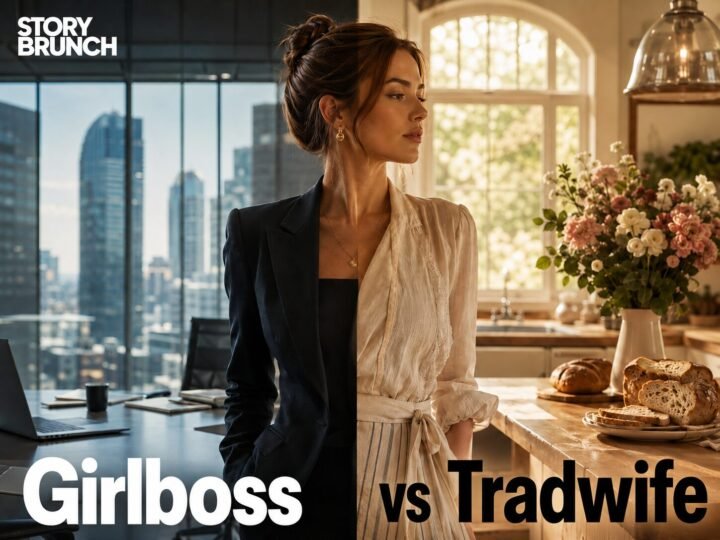
They disagree about where a woman should stand, but they agree on something quieter and more revealing: she should be legible. The girlboss is legible through visible achievement. The tradwife is legible through visible devotion. One holds a laptop. The other holds a loaf of bread. Both are asked to hold still long enough for the internet to decide what kind of woman she is.
Both promise control, though they locate it in opposite places. The girlboss says control comes from income, title, ownership, confidence, and a calendar full enough to prove demand. The tradwife says control comes from rhythm, marriage, motherhood, faith, home, and a world made small enough to manage. Neither desire is foolish. Money can protect a woman. A peaceful home can heal her. The problem begins when either promise becomes total. Money without care becomes another treadmill. Home without agency becomes another room with a locked door.
The blazer and the apron are not opposites when both are costumes for being judged.
Both hide labor. The girlboss image hides the work of networking, self-branding, late-night emails, emotional armor, and the thousand small negotiations required to be taken seriously without being punished for seriousness. The tradwife image hides the work of cooking, cleaning, soothing, planning, pregnancy, childcare, kinship management, sexual availability, and the emotional weather system of family life. One calls it hustle. The other calls it feminine nature. In both cases, the labor can disappear inside the story being told about it.
Both carry a class fantasy. The girlboss fantasy says anyone can rise if she works hard and packages herself well. The tradwife fantasy says one income can sustain a beautiful family life if women return to the old order. Both stories can be true for some people and cruel for others. They depend on money, health, race, immigration status, geography, partner behavior, childcare access, debt, and luck. The woman with no paid leave, no savings, and no reliable co-parent is not living a failure of branding. She is living inside political choices.
The best version of either requires an exit. A good career should not require self-erasure. A good home should not require helplessness. The best version of girlboss ambition is not domination; it is competence with dignity. The best version of domestic life is not submission; it is care with protection. In both cases, the test is simple: can she leave, rest, renegotiate, or change without being destroyed?
Plate VII – The Hidden Machinery
Both scripts monetize female identity
The girlboss turned ambition into a lifestyle product: planner, course, conference, tote bag, accelerator, podcast, lipstick, newsletter. The tradwife turns domesticity into a lifestyle product: apron, cookbook, sourdough starter, homeschool guide, supplement code, fertility ideology, affiliate link. One sells the office as self-actualization. The other sells the kitchen as sanctuary.
This does not make every participant cynical. Many women found real confidence through career feminism. Many women find real joy in homemaking, motherhood, faith, gardening, cooking, and family life. The problem begins when an individual preference becomes a totalizing morality tale. Then the woman with a job is selfish. The woman at home is oppressed. The ambitious woman is unfeminine. The dependent woman is pure. The internet loves these binaries because binaries are easy to package.
The premium edit of tradwife life also hides its labor. Fresh bread is work. Homeschooling is work. Pregnancy is work. Emotional regulation is work. Supporting a partner’s career is work. Managing kinship, birthdays, laundry, nutrition, illness, and a child’s inner world is work. The fact that it is unpaid does not make it natural. The fact that it is intimate does not make it effortless.
Girlboss culture hid a different labor: the labor of constant self-branding. It asked women to be competent but not cold, assertive but not abrasive, beautiful but not frivolous, rich but relatable, exhausted but grateful. Tradwife culture flips the pose but not the surveillance. Now she must be peaceful but productive, submissive but entrepreneurial, maternal but desirable, natural but camera-ready.
Plate VIII – The Missing Women
The nostalgia is selective
When people say “traditional,” they often mean a narrow postwar image: a male breadwinner, a female homemaker, children in a detached house, and enough income for one paycheck to carry the family. But that arrangement was never universal. Poor women worked. Black women worked. Immigrant women worked. Farm women worked. Domestic workers made other women’s domestic ideals possible. The “traditional wife” often depended on someone else’s underpaid labor, racial exclusion, inherited wealth, or public subsidy that nostalgia forgets to mention.
This is why the girlboss/tradwife debate can feel so strangely weightless. It often centers women with enough visibility to turn their choices into brands. The cashier, nurse aide, teacher, hotel cleaner, single mother, undocumented caregiver, disabled woman, adjunct professor, and exhausted grandmother rarely get to aestheticize the choice between empire and hearth. They are already holding the system up.
A better conversation would ask less “Which feminine identity is correct?” and more “Who has real options?” Can a woman survive if a marriage ends? Can she leave a bad job? Can she have a child without losing her career? Can a man reduce hours without being punished? Can care be shared without applause? Can domestic labor count before it becomes Instagram content?
Plate IX – The Exit From The Binary
The third script is sovereignty, not branding
The answer to girlboss burnout is not compulsory homemaking. The answer to tradwife dependence is not compulsory corporate ambition. The answer is to make both work and home less punishing, less gendered, and less total.
Economic agency is not cynicism. Every adult needs money, skills, legal knowledge, credit access, and some kind of exit plan, even inside loving relationships. This is not a refusal of romance. It is respect for the fact that illness, death, abandonment, divorce, and ordinary human change are part of life. A woman can trust a partner and still need her own footing.
Shared care is not help. Men should not be praised as heroic for doing ordinary household and childcare labor. It is not “help” when the home also belongs to them. It is membership. A culture that tells women to choose between career and home while letting men keep both is not defending tradition. It is defending asymmetry.
A humane life is not built by choosing the perfect feminine script. It is built by refusing to let one person carry the whole script alone.
Ambition should have a human body. Work can be meaningful, creative, prestigious, and financially necessary. But ambition should not require self-erasure, delayed motherhood, health collapse, or constant availability. The workplace has to become more honest about care, time, disability, grief, and bodies that cannot be optimized forever.
Domesticity should be honored without being romanticized. Homemaking is valuable work when chosen freely, protected financially, and respected as labor. It becomes dangerous when it is treated as a woman’s natural duty, when dependence is framed as purity, or when beauty is used to hide the absence of power.
A life is allowed to revise itself. A woman can want a career at 25, home at 32, school at 38, leadership at 45, and rest at 50. She can want none of these on the expected schedule. She can change because her desires change, or because circumstances do. A life is not a brand bible. It is a long conversation with reality.
The most radical sentence in this debate may be very plain: women should not have to convert their survival strategies into moral identities. Some will lead companies. Some will raise children full time. Some will do both badly for a while, then better, then differently. Some will refuse marriage. Some will build it carefully. Some will love domestic work. Some will buy dinner and feel no shame. The point is not to crown a new archetype. The point is to stop demanding one.
FAQs
Frequently asked questions
What is the difference between a tradwife and a stay-at-home mother?
A stay-at-home mother is a family role: she is not in paid employment and focuses on childcare or household work. A tradwife is an identity and often a public-facing aesthetic or ideology. Many stay-at-home mothers are not tradwives; many reject submission, political traditionalism, or online performance.
Is tradwife culture always far-right?
No. Tradwife content exists on a spectrum. Some creators focus on homemaking, faith, motherhood, or rural aesthetics without explicit extremist politics. But researchers have documented tradwife spaces that overlap with anti-feminist, nationalist, white supremacist, or far-right communities, so the political context matters.
Why did people turn against the girlboss?
The backlash came from several directions: burnout with hustle culture, scandals at women-led brands, criticism that elite feminism ignored class and race, and frustration with empowerment language being used to sell ordinary capitalist overwork.
Is wanting to be a homemaker anti-feminist?
No. Feminism at its strongest defends meaningful choice, including domestic life. The concern is not homemaking itself; it is coercion, financial dependence without protection, romanticized submission, and the claim that one family model should define all women.
Is wanting a powerful career anti-family?
No. A career can support family life, identity, security, and service. The problem is a workplace culture that treats care responsibilities as private inconveniences and rewards total availability as proof of seriousness.
What is the healthiest alternative to girlboss vs. tradwife?
The healthiest alternative is not another label. It is a life with economic agency, shared domestic labor, real rest, legal and financial protection, community support, and permission to choose work, home, or both without turning the choice into a purity test.
Citations
Sources and further reading
- Wired, “Why You Should ‘Lean In’ to Sheryl Sandberg‘s New Book” – contemporary coverage of the 2013 Lean In moment.
- Teen Vogue, “Nasty Gal‘s Sophia Amoruso… and Her Crazy-Popular New Book, ‘#GirlBoss'” – coverage of Amoruso and the 2014 #Girlboss book.
- InStyle, “How Girlboss’s Sophia Amoruso Started Over After Bankruptcy and Divorce” – background on the Nasty Gal bankruptcy and Amoruso‘s post-Nasty Gal turn.
- Sykes and Hopner, GNET, “Tradwives: The Housewives Commodifying Right-Wing Ideology” – research-based analysis of tradwife influencer ideology and platform strategy.
- The Guardian, “Sundresses and rugged self-sufficiency…” – 2024 analysis of TikTok tradwife aesthetics, politics, and nostalgia.
- McKinsey & Company, “Women in the Workplace 2025” – current data on women in leadership, entry-level opportunity gaps, and corporate commitment.
- Pew Research Center, “In a Growing Share of U.S. Marriages, Husbands and Wives Earn About the Same” – earnings and time-use patterns in U.S. marriages.
- U.S. Bureau of Labor Statistics, “Women in the labor force, 2023” – women’s labor-force participation, telework, household activities, and care data.
- Time, “Pop Culture Is Finally Getting Over the Girlboss Heroine. What Comes Next?” – analysis of the girlboss backlash in pop culture.