
The AI Side-Hustle Economy: What Actually Makes Money, and What Just Sells Courses

The AI Side-Hustle Economy: What Actually Makes Money, and What Just Sells Courses
Everyone online is getting rich with AI, or selling a course about it. We audited the difference — the real earnings, the real timelines, and the tell that separates a business from a bezzle.
Try an experiment before you read any further. Open a new tab and search “AI side hustle.” Every result on the first page will announce itself as the honest one — the no-hype guide, the real numbers, the article that finally tells you what the others won’t. Read three of them and you’ll notice they can’t all be the only honest one, and that most of them end at the same place: a tool with an affiliate link, a newsletter, or a $297 course. The genre has a tell, and the tell is that the people writing “how to make money with AI” are, overwhelmingly, making their money by writing “how to make money with AI.”
That is not a reason to dismiss the whole thing. Underneath the funnel there is a real economy, with real people earning real money — just not the money in the thumbnails, and not the way the thumbnails claim. This piece is an audit of that economy. We’re not going to sell you a system, because we don’t have one and the ones being sold are mostly the product. We’re going to separate three things the hustle content deliberately blurs: what genuinely earns, what the honest earnings actually are, and the structural reason so much of the “advice” is really an advertisement.
The audit, in brief
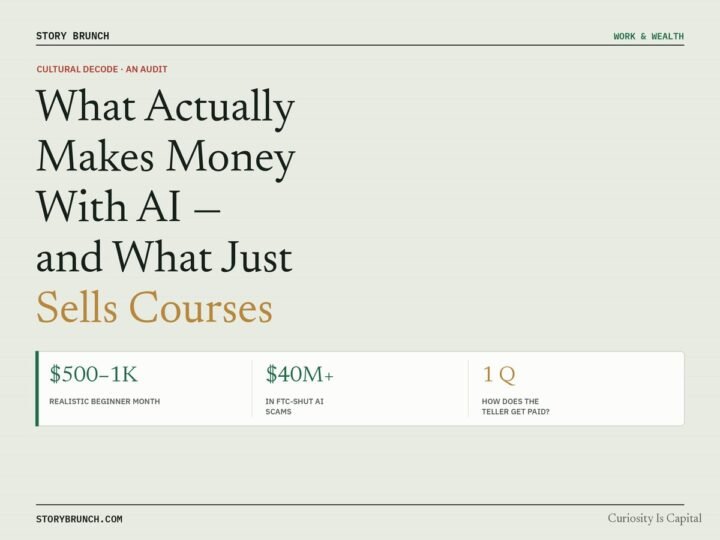
The AI-income economy is real but modest, and front-loaded with hype. Independent reporting and freelance-platform data converge on the same picture: beginners realistically earn $500–$1,000 a month in their first six months — not the “$300 a day” of the thumbnails — and reaching $5,000+ typically takes another 6–12 months of skill-building and client acquisition. The reliable pattern across every credible source: AI works as leverage on a skill you already have, never as a replacement for having one.
The scams are real too, and regulators are now moving. The U.S. Federal Trade Commission’s “Operation AI Comply” shut down multiple AI “passive income” schemes across 2025–2026, with reported consumer losses exceeding $40 million — including a single case (Ascend Ecom) alleging at least $25 million defrauded via promises that AI tools would generate thousands in monthly passive income. The single most useful skill in this whole economy is telling a business from a bezzle.
What actually earns
Strip away the branding and the genuinely income-producing uses of AI collapse into one sentence: someone who already understands a customer uses AI to serve that customer faster. Every durable example is a variation on it. A social-media manager uses AI to draft twenty caption options in five minutes, keeps the best five, and takes on more clients than she could writing by hand — the AI didn’t replace her judgment, it multiplied her output. A person with domain knowledge in a trade builds simple, focused chatbots for local businesses in that trade. A marketer with a decade of context sells AI-assisted content where the AI drafts and the human edits, and the client pays for the finished result, not the tool.
The through-line the honest practitioners keep repeating: the human element is not optional, it is the product. AI can summarize what’s already known; it cannot tell a specific business which strategy fits its specific constraints, cannot hold the client relationship, cannot make the judgment call about which of the twenty options is actually right. As one tested breakdown put it bluntly: nobody is being replaced by AI right now — people are being replaced by other people who use AI better. That gap, and not any tool, is the opportunity.
Which is also why the most-hyped models are the ones that fail. Fully-automated AI content farms briefly rank and then collapse as search engines improve at detecting them — a house of cards, in the words of multiple practitioners. Generic AI blog content sells for under $50 an article to clients who can generate it themselves. “AI courses about AI” is the most saturated niche of all. The rule is consistent: the more completely AI does the thinking, the faster the market competes the value to zero, because if a machine can do it alone, your customer can run the same machine.
The honest earnings, on the record
Here is the table the thumbnails never show — the realistic earnings arc as reported across freelance-platform data and independent, self-tested accounts through 2026. Read it as a floor-and-ceiling range with wide variance, not a promise; plenty earn nothing in the early months, and a minority scale well past the top row.
| Stage | Realistic monthly | What it takes |
|---|---|---|
| Beginner (0–6 mo) | $500–$1,000 | One focused service, actively marketed. First paying client usually lands in 2–6 weeks; many earn near zero at first. |
| Building (6–18 mo) | $1,000–$5,000 | Client acquisition and a real niche. The slow middle where most quit. |
| Skilled niche | $3,000–$8,000 | 2–4 ongoing retainers, a specialty, some technical ability. Upwork 2026 data: freelancers who can script earn 40–60% more per hour. |
| Productized / agency | $10,000–$25,000 | Fixed-price packages, a client-acquisition system, and months of consistent grind. The genuine top, and it is a business, not a hustle. |
One figure worth holding onto for perspective: independent reporting puts the average side hustle of any kind at well under $1,000 a month. AI raises the ceiling for the skilled and the persistent; it does not change the fact that most side hustles, AI or not, stay small. Anyone quoting you a typical five-figure month is quoting you the exception as if it were the rule — which is the oldest move in the genre.
Sell the shovels, not the gold
During the 1849 gold rush, the reliable fortunes weren’t made by the miners. They were made by the people selling picks, shovels, and jeans to the miners — a steady margin on hope, indifferent to whether any given prospector struck anything. The AI side-hustle economy has rebuilt that structure with startling fidelity, and once you see it you cannot unsee it.
The “gold” is the promise: quit your job, earn passively, let the machine work while you sleep. The “shovels” are what’s actually sold to people chasing that promise — the $297 courses, the coaching programs, the paid communities, the affiliate-linked tool subscriptions, the templates. The reliable money in this economy is overwhelmingly shovel money. The FTC’s enforcement actions make the extreme version explicit: in the schemes it shut down, the operators’ real revenue came from selling the system, not from any income the system produced — the passive income was the bait, the course was the business. But the legal, everyday version runs on the same logic. When an article’s genuine product is the affiliate commission on the tool it recommends, its incentive is your signup, not your success, and those two things quietly diverge.
This is the single most clarifying question you can bring to any “make money with AI” content, including honest-seeming content: how does the person telling me this actually get paid? If the answer is “when you buy the thing I’m linking,” you are not reading advice — you are reading an advertisement that has learned to sound like advice. It may still contain true information. But the truth in it was selected to sell, and selection is where the distortion lives.
In fairness: not every course is a scam and not every affiliate link is a con — some educators deliver genuine value, and disclosure-compliant affiliate content is legitimate. The point isn’t that recommendation equals fraud. It’s that incentive shapes information, and knowing who profits from your belief is the first and cheapest form of due diligence.
Signal or Shovel?
Eight claims in the style of real AI-income content. For each, decide: is it a SIGNAL (a realistic description of how the money actually works) or a SHOVEL (a pitch engineered to sell you something)? The skill transfers directly to your search results.
Five questions that cut through the noise
If you strip this entire economy down to a portable toolkit, it’s a short list of questions to ask of any AI-income claim — the same questions a skeptical auditor would ask of any investment pitch.
1. How does the messenger get paid?
Course sale, affiliate link, or their own actual side-hustle revenue? The first two mean you’re the customer, not the student.
2. Does it require a skill, or promise to replace one?
Claims built on “leverage your expertise” describe the real economy. Claims built on “no skills needed, fully automated” describe the bezzle. Every credible source lands on the former.
3. Is the number a median or a maximum?
“People are earning $15,000 a month” is almost always a ceiling quoted as a norm. Ask what the typical person earns, and whether the quoter knows the failure rate — they usually don’t, because failures don’t post.
4. Would this survive everyone doing it?
If the method is “generate content and publish at scale,” it dies the moment it’s crowded — which, being publicized, it already is. Durable income solves a specific problem for a specific customer who can’t easily do it themselves.
5. Does it promise passive income with no effort?
This is the reddest flag the FTC names. Real AI income is a business — client acquisition, sales rejection, iteration, grind. “Passive, guaranteed, no work” is the exact grammar of the schemes that got shut down.
Questions this audit gets asked
Can you really make money with AI in 2026?
Yes, but realistically and gradually. Independent data and freelance-platform figures point to beginners earning $500–$1,000 a month in their first six months, growing to $3,000–$8,000 for skilled specialists and $10,000+ for productized agencies — over 12–18 months of consistent work. The reliable model is using AI to deliver a service faster in a field you already understand, not “passive income” from automation.
What’s the most realistic AI side hustle for a beginner?
An AI-assisted service in a domain you already know something about: AI-supported content or social media for small businesses, simple custom chatbots for a specific local trade, or workflow automation setup. Services pay fastest; the common advice across every credible source is to pick exactly one, market it actively, and expect the first client within a few weeks — not a passive windfall.
Are AI side hustles a scam?
The legitimate ones aren’t; the “passive income, no skills, guaranteed” ones frequently are. The FTC’s Operation AI Comply shut down multiple AI income schemes across 2025–2026, with over $40 million in reported consumer losses. Red flags: guaranteed returns, high-priced courses ($500+), and promises of passive income with no effort. Real AI income requires skill, client acquisition, and sustained work.
Why do so many “AI money” articles feel like ads?
Because many are. A large share of AI-income content earns via affiliate commissions on the tools it recommends or via courses it sells — meaning its incentive is your signup, not your success. The information may still be accurate, but it’s selected to sell. The defense is a single question: how does the person telling me this get paid?
Sources
- U.S. Federal Trade Commission — Operation AI Comply enforcement actions (2024–2026), including the Ascend Ecom case.
- Upwork 2026 freelancer data on AI-skill hourly premiums, as reported across industry coverage.
- Independent self-tested income breakdowns and practitioner reporting (Side Hustle School and multiple 2026 first-person audits).
- Aggregated freelance-platform earnings ranges and the FTC’s published scheme-loss figures.
Method note: this is analysis, not financial or career advice. Figures are ranges reported by third parties through mid-2026 and carry wide variance; nothing here is a promise of earnings, and Story Brunch has no course to sell you — which is rather the point.
Related on Story Brunch
