How to Spot a Dark Triad Date Before the Second Drink: 9 Tiny Red Flags Psychologists Want You to Know

Story.Brunch
Dating · 7 min read
Dating · Psychology
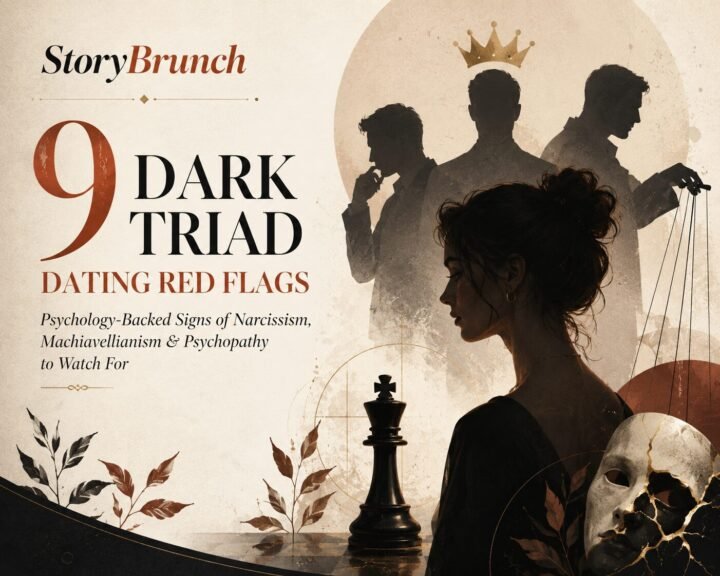
How to Spot a Dark Triad Date Before the Second Drink
Nine tiny red flags — backed by personality psychology — that show up earlier than you think. Save this. Send it to the friend who’s about to ignore it.
Here’s the awkward truth about dating someone with high Dark Triad traits: you almost never realise it on the first date. You realise it six months in, while explaining to a friend why your phone is full of two-thousand-word voice notes and you’ve apologised for things you didn’t do.
The Dark Triad — narcissism, Machiavellianism, and psychopathy — was coined by psychologists Delroy Paulhus and Kevin Williams back in 2002. They are three socially toxic personality traits that often cluster together, and the people who score high on them are remarkably good at first impressions. They’re charming. They’re confident. They make you feel chosen. That’s the entire point — that’s how it works.
But the cues are there. Tiny ones. Things that, if you knew to watch for them, would have you politely closing the tab and going home to your dog before the appetisers arrived. Here are nine of them.
Read This First
One red flag isn’t proof. Three is a pattern.
Most of these behaviours, in isolation, can show up in anyone having a weird night. You’re looking for clusters. If three or four of these land in the same date, you have your answer. And if your gut is already nervous before you reach number nine, that’s information too.
1
The Velocity Issue
They’re already in love with you. You haven’t ordered yet.
Healthy people are interested. Dark Triad people are certain. By the time the bread arrives, they’ve decided you’re “different from everyone else they’ve met,” “weirdly easy to talk to,” and “exactly what they didn’t know they were looking for.”
⚑ Sounds Like
“I knew within the first five minutes. I’ve never said that on a first date before, but with you it’s different.”
Psychologists call it love bombing, and the research consistently links it to narcissism and Machiavellianism. The point isn’t romance — it’s destabilisation. Once you’re emotionally floating, you stop noticing the floor isn’t there.
2
The Waiter Test
They are warm to you and cold to the server.
This one is so reliable that hiring managers use a version of it. Watch how your date treats the people who can’t benefit them — the server, the bartender, the Uber driver, the bathroom attendant. Dark Triad personalities are remarkably good at charming up the social ladder and dismissive of anyone they perceive as down a rung.
⚑ Watch For
A subtle shift in tone when the server arrives. The smile that drops. The slightly imperious “Can we…” The eye-roll when the kitchen takes too long.
Empathy is not a tap they can turn on for one person. If it’s switching off for the waiter, it’s switching off for you eventually. Believe the version of them that the world sees, not the version they perform for an audience of one.
3
The Ex Pattern
Every ex was “crazy.” All of them. Each one.
Listen carefully when they talk about previous relationships. One difficult ex is a story. Two is a coincidence. Three or more where every former partner is described as unstable, jealous, dramatic, or “obsessed with me” — that’s a pattern. And in dating, the only thing all your relationships have in common is you.
⚑ Sounds Like
“Honestly, I’ve just had the worst luck. My last three were all really unstable. I don’t know what it is about me that attracts that kind of person.”
Notice the framing: it’s never their behaviour, always the other person’s psychology. Dark Triad personalities consistently externalise blame — it’s the foundation of how the manipulation works. If they take zero responsibility for any past relationship, they will not take any for the next one.
4
The Mirror Move
You have so much in common it’s almost suspicious.
You love the same obscure band. You’re both reading the same translated Korean novel. They’ve also been meaning to learn pottery. Their favourite film is — what a coincidence! — also yours. By dessert, they feel like the version of you you’ve been waiting to meet.
⚑ The Sleight of Hand
They asked you ten questions. You answered each one. Then they handed your own answers back to you, lightly reshaped, and called it “soulmate energy.”
This is what psychologists call identity mirroring. It’s not connection — it’s a sales technique. The fastest way to make someone trust you is to look like them. Healthy people discover compatibility over time. Dark Triad personalities manufacture it inside ninety minutes.
5
The Subtle Test
There’s a tiny push when you say no to something small.
This one is so small you’d miss it if you weren’t looking. You say no to a second drink. They tease you for it. You’d rather not split the dessert. They look mildly wounded. You mention you have an early morning. They say “Of course,” but the temperature in the conversation drops by two degrees.
⚑ Sounds Like
“Oh come on, you can’t be that boring.” (Said with a smile, of course. Always with a smile.)
Dark Triad personalities run boundary tests early, on low-stakes issues, to see how easily you’ll cave. Every “yes” you give to something you wanted to say “no” to is data. They’re not checking if they can have another round of drinks. They’re checking how negotiable you are.
Halfway There. Stay With It.
6
The Story Audit
Every anecdote ends with them being incredible.
Listen to the shape of their stories. In a normal person’s anecdotes, they screw up sometimes. They have moments of doubt. They make the joke at their own expense. In a high-narcissism person’s stories, they emerge from every conflict as the smarter, kinder, more reasonable party. Their boss didn’t appreciate them. Their friend was being ridiculous. Their family doesn’t understand them.
⚑ Listen For
The complete absence of self-deprecation. Even the “self-aware” stories somehow circle back to how thoughtful they are for noticing.
Most people anchor their identity in something other than being-the-best-in-every-story. Listen for who the hero is in every anecdote. If it’s always them, you’re being told something important about how the next year of your life would feel.
7
The Tiny Lie
Something small doesn’t quite add up.
Their job title shifted slightly between the dating app and the first drink. They told you they grew up in one city, then mentioned a high school in another. Their age changed by a year. The book they “love” they actually haven’t quite finished. Tiny lies. The kind you’d never confront.
⚑ The Pattern
Each lie is too small to mention, easy to brush off. But the willingness to lie about nothing — the casual, victimless edits to reality — tells you everything.
Research on Machiavellianism consistently shows that high scorers lie more often and with less guilt — even when there’s no clear benefit. If they’ll lie about a book, they will lie about a feeling. The size of the lie doesn’t matter. The reflex does.
8
The Emotional Asymmetry
They share something heavy way too soon — or way too coolly.
One version: forty minutes in, they’ve told you about their estranged family, their last breakup, their therapy, and a serious health scare — all delivered with the practised intensity of someone who has told this story many times. The aim is to short-circuit normal pacing, create false intimacy, and make you feel chosen for being trusted.
The other version: they describe genuinely terrible things — a parent’s death, a serious accident, a betrayal — with eerie composure, like they’re reading them from a menu. Both should make you pause.
⚑ Two Signals, Same Source
Premature heavy disclosure = Machiavellian intimacy hack. Flat affect around serious topics = a marker associated with psychopathy in clinical literature.
Healthy intimacy paces itself. Whether they sprint emotionally or stay strangely still around heavy material, the calibration of their emotional response is the data point — not whether they have a sad story.
9
The Gut Check
You feel a tiny “off” you can’t justify out loud.
This is the most important flag and the hardest one to honour. You can’t point to anything specific. On paper, it was a fine date. They were attractive, attentive, funny in places. The bill got paid. But somewhere between the appetiser and the cab home, a small, soft alarm started ringing in the back of your chest, and it’s still ringing.
⚑ What It Feels Like
Slight performance-anxiety afterward. Replaying things you said. A weird urge to convince yourself it was great. The friend you text downplays your discomfort — and you feel relieved.
Your nervous system processes hundreds of micro-cues your conscious mind can’t articulate — eye contact patterns, pauses, asymmetries between word and tone. The “off” feeling is the integration of all of them. It is, statistically, the most reliable warning signal you have. Listen to it before you talk yourself out of it.
The most dangerous person in your dating life is rarely the one who looks dangerous. It’s the one who looks perfect.
— A truth literally every therapist will eventually tell you
⌖ The Real Takeaway
A healthy person can survive your boundaries.
Here is the single most useful filter you have: healthy people do not punish you for slowing down. They don’t sulk when you don’t want a third drink. They don’t get cold when you say you’d rather not stay over. They don’t perform “I knew it” energy when you suggest a second date next week instead of tomorrow.
Dark Triad personalities cannot tolerate being unable to control the pace. That is the test. Slow down on purpose, and watch what happens. The result of that one small experiment will tell you more than nine red flags ever can.
And, look. None of this is a diagnosis. Nine flags isn’t a clinical assessment. But dating isn’t a clinical setting — it’s pattern recognition under low information. Trust the patterns. The dog at home will be glad you came back early.
Quick Questions, Honest Answers
What exactly is a “Dark Triad date”?
Someone showing elevated levels of three personality traits identified by psychologists Paulhus and Williams in 2002: narcissism (grandiosity), Machiavellianism (manipulation), and psychopathy (low empathy). High scorers often perform charm beautifully on early dates while struggling with the kind of empathy that long-term partnership requires.
Can someone really show Dark Triad traits on a first date?
Yes — research suggests several traits leak even in brief interactions. The signals are often subtle (treatment of service staff, story shape, mirroring patterns), but they are observable if you know what to look for.
Isn’t love bombing just being enthusiastic?
Enthusiasm is calibrated to what you actually know about each other. Love bombing outpaces reality — declarations of certainty before any real information has been exchanged. The pattern, not the intensity, is the giveaway.
What’s the single best protective move?
Slow down on purpose and observe their response. Healthy partners don’t penalise pacing. Dark Triad personalities tend to test, push, or quietly punish it.
Are women equally likely to have Dark Triad traits?
Men score slightly higher on average on most Dark Triad measures, but the gap is smaller than people assume, and women high on these traits often go undetected because cultural expectations skew our suspicions. The flags work either way.