
The Loverboy Method: How Traffickers Weaponise Love

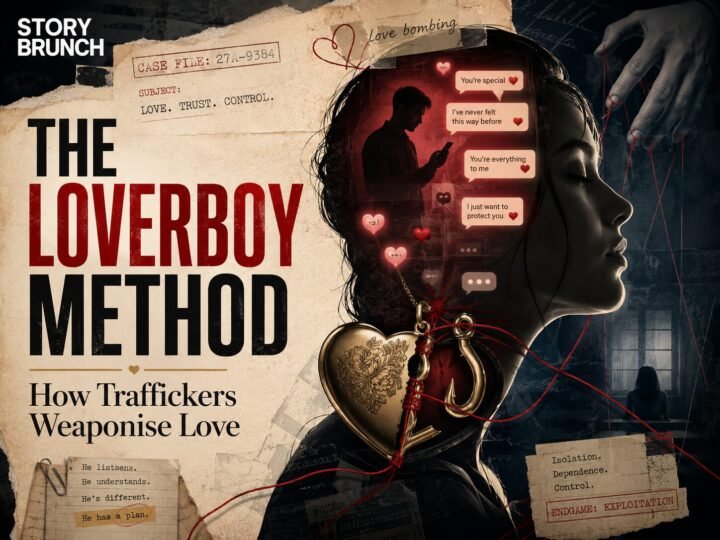
The Loverboy Method: How Traffickers Fall in Love, Go to Work
It looks like the best relationship of her life. That is the entire design. Inside the recruitment technique that has quietly become Europe’s most common route into sexual exploitation — and the myths that keep it working.
He is the most attentive person she has ever met. He remembers the small things — the name of her least favourite teacher, how she takes her coffee, the argument she had with her mother on Tuesday. He texts good morning before she wakes and good night after everyone else has stopped bothering. When she says her family doesn’t really understand her, he says he does, and for the first time in a long time someone seems to. There are gifts. There is a plan for the future with her name in it. If you described the first two months to any of her friends, they would say she was lucky.
None of it is real, and all of it is technique. The warmth is a budget. The listening is reconnaissance. The future with her name in it is inventory planning. Somewhere between eight weeks and eight months from that first good-morning text, the man who studied her so carefully will use everything he learned — the insecurities, the family rift he helped widen, the isolation he engineered one cancelled plan at a time — to move her into commercial sexual exploitation, and to keep her there through a bond she will, at first, defend to the police. This is the loverboy method, and it is not a dark-alley crime. It is a courtship, weaponised.
The short answer, before the long one
The “loverboy method” is a human-trafficking recruitment technique in which a trafficker feigns a romantic relationship to psychologically bond a victim to him, then leverages that bond to coerce her into prostitution or other sexual exploitation. The term originated in the Netherlands in the mid-1990s; Dutch authorities officially call these traffickers “romeo pimps,” and in Dutch they’re known as tienerpooiers (“teenage pimps”). Victims are overwhelmingly young women and girls, though anyone can be targeted.
It has become one of Europe’s dominant recruitment routes. Germany’s Federal Criminal Police (BKA) attributed 21% of identified sexual-exploitation victims in 2023 to the loverboy method. It entered wider public awareness in 2022–23 when Romanian prosecutors named the technique in the trafficking case against influencer Andrew Tate. And the single most important fact about it is corrective: the technique works precisely because most people picture trafficking as kidnapping. It almost never is.
The myth is the trafficker’s best friend
Ask most people to picture human trafficking and they will describe a scene from a Liam Neeson film: a van, a snatch, a girl who wakes up in a shipping container. Survivor-educators who train law enforcement say this image is not merely inaccurate — it is actively dangerous, because every hour spent watching for the van is an hour of not seeing the boyfriend. One survivor-turned-trainer, who says she has trained over 100,000 officers, puts the figure starkly: stranger abduction accounts for a tiny fraction of trafficking. The overwhelming majority of victims are recruited by someone they know and trust — a partner, a family member, a person who got close on purpose.
The Myth
A stranger abducts a girl by force. It happens fast, in public, to someone else’s family. You’d see it coming. The warning signs are zip-ties on car handles and drugged roses.
The Documented Reality
A trusted person manufactures love over weeks or months. It happens slowly, in private, often to well-supported young people. You wouldn’t see it — that’s the design. The warning signs are subtle shifts in mood, money, and contact.
Every viral “trafficking safety” post about parking-lot tricks does the real traffickers a quiet favour: it trains the public to guard the one door criminals almost never use, while the actual door — a charming message from someone who seems to understand — stays wide open. The loverboy doesn’t fight the myth. He hides behind it.
Five stages of a manufactured love
Anti-trafficking organisations across the Netherlands, Belgium, and Germany describe a recognisable arc. It is not always linear, and not every case has every stage — but the shape recurs often enough that counsellors teach it as a pattern. Reading it is the closest thing to an inoculation.
The Selection
The target is chosen for need, not naivety — anyone seeking recognition, love, or stability qualifies. Risk factors include family conflict, low self-esteem, economic insecurity, and time in the care system, but counsellors stress that confident, well-supported young people are targeted too. Increasingly the selection happens online, where a profile broadcasts vulnerabilities the recruiter can mirror.
The Love-Bombing
Overwhelming affection, attention, and gifts, delivered fast. He becomes the most important person in her life at a speed that feels like fate and is actually method. This is the stage that looks, to outsiders, like an enviable romance — and the stage victims later find hardest to reinterpret as an attack.
The Isolation
Friends become rivals for her time; family becomes the enemy who “doesn’t get it.” Each severed tie is one fewer person who might notice the change and say something. By the end of this stage, he is not just her partner — he is her only remaining source of reality.
The Turn
The exploitation begins, often disguised as a favour for the relationship: “just this once,” to pay a sudden debt, to help him out of trouble he manufactured. Compromising photos obtained earlier become blackmail. The affection that flowed freely is now conditional on compliance — the switch the whole structure was built to throw.
The Trauma Bond
Intermittent cruelty and tenderness — the cycle that makes trauma bonds so tenacious — keep her attached to her own abuser. This is why victims often defend the trafficker to police, decline to press charges, and return after rescue. The bond is not weakness or foolishness; it is the predictable output of a deliberately engineered psychological process.
Why it holds even after discovery: the same intermittent-reward cycle that drives other behavioural compulsions makes the trauma bond neurologically sticky. Understanding this is the difference between asking a victim “why didn’t you just leave?” — a question that shames — and asking “who made you believe you couldn’t?” — a question that helps.
What social media changed
The method is thirty years old; its delivery system is brand new, and the upgrade has made it faster and wider. When the term was coined in 1990s Rotterdam, a loverboy worked in person, one target at a time, over a long seduction. Today, anti-trafficking agencies in the Netherlands and Belgium report the grooming phase has compressed dramatically — what once took a year can now take weeks — for three structural reasons.
Scale: a recruiter can run many targets simultaneously through direct messages, on social platforms and in the chat functions of online games, from anywhere. Intelligence: a public profile hands the recruiter a dossier — insecurities, relationship status, grievances, the exact emotional openings to mirror — that once took weeks of in-person work to gather. Reach: he is no longer limited to the girls in his neighbourhood; the Dutch government explicitly notes that social media has widened both the contact pool and the information available on each potential victim. The Belgian referral centre Payoke reports the overall luring process is now significantly shorter than in the past — which it calls, precisely because of that speed, all the more worrying.
A note on numbers: trafficking is chronically under-reported and definitions vary by country, so every figure here is a floor, not a ceiling. The BKA’s 21% counts only identified victims in cases that reached the statistics — the invisible remainder is, by the nature of the crime, uncounted.
How a term left the caseworkers’ offices
For most of its life the word “loverboy” lived in Dutch and Belgian social work, in police reports and NGO pamphlets, largely unknown to the English-speaking public. That changed at the end of 2022, when Romanian prosecutors from the organised-crime directorate DIICOT arrested the influencer Andrew Tate and his brother, and named the loverboy method by name in laying out their allegations. The prosecutors alleged the brothers formed an organised criminal group to recruit women through feigned romantic or marriage promises, then coerced them into producing pornographic content — the loverboy arc, industrialised. The Tate brothers have denied wrongdoing, and the case continues through the Romanian courts; nothing here asserts a conviction that has not been entered.
What matters for this piece is the aftermath rather than the verdict: the case triggered a wave of explainer videos, many from survivors and former anti-trafficking workers, that did in a fortnight what a decade of pamphlets couldn’t — put the mechanics of romance-based recruitment in front of tens of millions of young people. The grim irony was not lost on those educators: the same influencer ecosystem that had spent years selling a certain audience of young men on dominance, “high-value” manipulation, and treating women as assets to be managed was now the venue in which those young men learned the clinical name for what that manipulation, taken to its criminal conclusion, is called. The teaching and the warning arrived on the same platform, in the same feed.
What it actually looks like from outside
Counsellors who work with families stress that no single sign is proof — most are ordinary adolescence. It is the cluster, the speed, and the change that matter. These are the patterns anti-trafficking organisations teach parents, teachers, and friends to notice:
If this describes someone you love, the worst move is confrontation that forces her to choose him — the isolation has likely already primed her to pick the trafficker over the accuser. The better move is staying connected without ultimatums, and contacting a specialist trafficking helpline (not a general emergency line) for guidance on how to help someone who does not yet believe she is a victim.
The problem with “loverboy”
There is a live argument among researchers about the term this entire article uses, and honesty requires airing it. “Loverboy” — like “romeo pimp” — is a soft word for a violent thing. Critics point out that the label half-romanticises the perpetrator, wrapping a rapist and trafficker in the language of boyish infatuation, and can subtly cast the victim as a girl who fell for a bad boyfriend rather than a person subjected to an organised crime. Some scholars argue the vocabulary itself reproduces the vulnerability, making these men harder to see and prosecute as what they are: traffickers.
The counter-argument is pragmatic: “loverboy” is the term victims, families, police, and prevention campaigns across Europe actually recognise, and a warning has to use the word people will search for. This piece keeps the term for that reason — findability saves people — while insisting on the correction the softer word obscures. So, once, plainly, for the record: a loverboy is not a boy, and there is no love in the method. He is a trafficker running a recruitment strategy, and the romance is the weapon, not a mitigating detail.
Questions this piece gets asked
What is the loverboy method?
It’s a human-trafficking recruitment technique in which a trafficker fakes a romantic relationship to emotionally bond a victim to him, then uses that bond to coerce her into prostitution or sexual exploitation. It originated in the Netherlands in the mid-1990s; officials there call these traffickers “romeo pimps.” Victims are predominantly young women and girls, but the method can target anyone seeking connection.
Where did the term “loverboy” come from?
From the Netherlands in the mid-1990s, where it described pimps who used seduction rather than force to recruit girls into prostitution. The Dutch term is tienerpooier (“teenage pimp”), and the official government designation is “romeo pimp.” Researchers have documented it as both a real criminal method and, at times, a media moral panic — the truth being that it is a genuine phenomenon that was also sensationalised.
Is the loverboy method the same as what Andrew Tate was accused of?
Romanian prosecutors (DIICOT) named the loverboy method when laying out their allegations that the Tate brothers recruited women via feigned romantic relationships and coerced them into producing pornographic content. The Tates deny wrongdoing and the case is ongoing. The case is significant less for any verdict than for bringing a previously specialist term to a global audience.
How is the loverboy method different from typical trafficking stereotypes?
Almost entirely. The stereotype is stranger abduction — fast, forcible, public. The loverboy method is the opposite: slow, consensual-seeming, private, built on a real emotional bond the victim helps construct. Stranger abduction accounts for a very small share of trafficking; recruitment by someone the victim knows and trusts is the norm, which is exactly why the method works.
Why don’t victims just leave?
Because they’re held by a trauma bond — an attachment engineered through cycles of affection and cruelty that is neurologically difficult to break, reinforced by isolation, shame, blackmail, and often genuine love for who they believed the person was. Asking “why didn’t she leave?” misunderstands the crime. The better question is who deliberately built the cage, and how.
Sources & further reading
- Bovenkerk, F. & van San, M. (2011), “Loverboys in the Amsterdam Red Light District,” on the phenomenon’s history and moral-panic dimension.
- Government of the Netherlands — official guidance on “romeo pimps” (loverboys) and the role of social media.
- KOK (German NGO Network against Trafficking) and the German BKA Federal Situation Report 2023 — the 21% figure for sexual-exploitation victims.
- Payoke (Belgium) and Child Focus — Flanders referral-centre data and the compression of the grooming phase.
- Europol — on the loverboy technique targeting those in economic and social hardship.
- Contemporary reporting on the DIICOT case naming the method (2022–2023), and survivor-educator interviews correcting abduction myths.
Method note: this article describes a criminal pattern using named institutional sources and does not depict any real victim; illustrative passages are composites written to convey documented tactics, not accounts of identifiable individuals. Where a live legal case is referenced, allegations are described as allegations.
Related on Story Brunch