Weaponized Empathy: When Kindness Is the Con (Take the Empathy Exploit Detector)

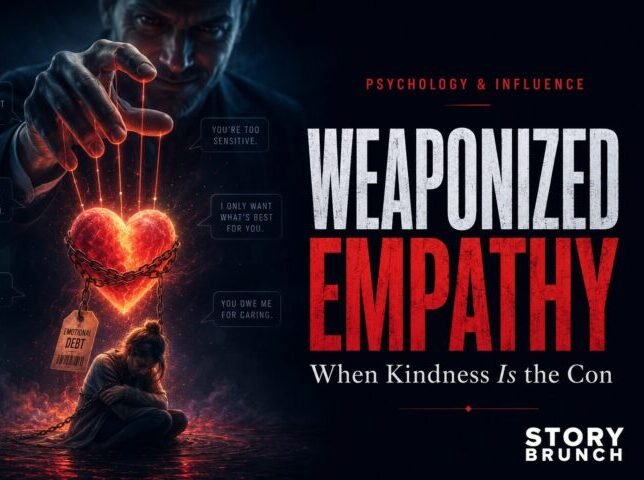
PSYCHOLOGY & INFLUENCE
Now meet Jonah — and watch every exploit run in sequence ↓
WEAPONIZED EMPATHY: WHEN KINDNESS IS THE CON
Nobody warned you about weaponized empathy, because every warning you ever got was about cruelty. The most effective operators don’t raise their voice. They raise your guilt — and they let your own compassion do the collecting.
SCORE YOURSELF
THE EMPATHY EXPLOIT DETECTOR
Ten short exchanges — texts, workplace messages, family conversations. Each one contains an emotional appeal. Pick what you would actually do, not the textbook answer. Your score reveals not just how reachable you are, but which exploit reaches you most: the Guilt Hook, the Confession Trap, the Martyr Bid, or the Honesty License.
YOUR EXPLOITABILITY SCORE
0
/ 20
YOUR DOMINANT EXPLOIT
THE NICEST PERSON MAYA EVER MET
What follows is a composite — Maya and Jonah are assembled from the case patterns that run through the coercive-control and covert-manipulation literature, because the pattern is so consistent it barely needs inventing. If parts of it feel familiar, that is not a coincidence. That is the point.
ACT I — THE GIFT
Jonah joined the company on a Tuesday, and by Friday he had fixed Maya’s broken standing desk, covered her afternoon meeting when her train was late, and left a coffee on her desk with a note that read: you looked like you needed this.
She hadn’t asked for any of it. That was what made it feel so warm — and what made it work. Within a month, Jonah was the nicest person Maya had ever worked with, and Maya had a feeling she couldn’t quite name. It was small and itchy and lived somewhere behind her sternum. It was the feeling of owing.
WHAT JUST HAPPENED
Unrequested favors are the opening move because they create debt without a contract. Maya never negotiated the terms — she can’t, because she never agreed to the exchange. Reciprocity research has shown for decades that unsolicited gifts produce compliance far out of proportion to their cost, and the covert operator’s refinement is patience: the invoice arrives months later, when refusing feels like theft.
The counter: gratitude and obligation are different currencies. You can pay the first in full and still refuse to pay the second — the two were never one transaction, they were only staged as one.
ACT II — THE CONFESSION
Six weeks in, at the end of a late night, Jonah told Maya about his childhood. It was a hard story, told quietly, and it ended with a sentence Maya would replay for a year: “I’ve never told anyone here that. I don’t know why I trust you. I just do.”
Maya felt chosen. She also felt, without noticing it, sealed — because you cannot casually mention a secret-keeper’s flaws to other people. From that night on, anything odd about Jonah’s behavior had an explanation she had been handed in advance, and a confidentiality clause she had signed with her sympathy.
WHAT JUST HAPPENED
This is strategic vulnerability — the confession trap. Genuine intimacy discloses gradually and mutually. Instrumental disclosure arrives early, arrives asymmetrically, and does three jobs at once: it fast-forwards trust past the stage where scrutiny lives, it pre-loads an excuse for future behavior (“he’s been through so much”), and it isolates, because the confidence makes comparing notes with others feel like betrayal.
The counter: respond to the disclosure with genuine care — and keep the request pipeline separate. Compassion for someone’s past is not consent to their next ask. Watch the timing: if intimacy reliably precedes an invoice, it was never intimacy.
ACT III — THE LEDGER OPENS
The first withdrawal was small. “Could you sign off on my numbers? I’m drowning this week — you know I’d never put you in a bad spot.” She signed. The second was bigger. The third came with a new tone, hurt arriving a half-second before the words: “Wow. After everything, you’re actually hesitating.”
And when Maya mentioned, once, that she was overloaded too, Jonah smiled the saddest smile in the building. “Don’t worry about me. I’ll handle it alone. Like always. You focus on you.” He stayed late that night where everyone could see the light on. Maya went home and felt like a war criminal.
WHAT JUST HAPPENED
Two exploits ran back to back. The guilt hook converts the unnegotiated debt of Act I into compliance: “after everything” is an invoice with no itemization, which is what makes it unpayable — and therefore permanent. Then the martyr bid: performed self-sacrifice, staged where the audience can see it, which manufactures guilt out of nothing but the target’s own decency. Notice that Jonah never asked for anything in that last scene. He didn’t need to. Maya’s empathy wrote the demand for him.
The counter: for the guilt hook, request the itemization — a real relationship survives “let’s talk about what we actually owe each other.” For the martyr bid, accept the stated words at face value: “Thank you — I will focus on me.” Martyrdom collapses when the audience declines to feel guilty; that is the one review it cannot survive.
Cruelty gets caught because it looks like what it is. Weaponized kindness gets promoted, thanked, and defended by its own victims.
ACT IV — THE HONESTY LICENSE
By spring, Jonah had appointed himself Maya’s truth-teller. “That presentation was honestly embarrassing — hey, don’t look at me like that, I’m the only one here who’ll be straight with you. Everyone else just flatters you.”
It landed like care. It functioned like a moat. Every criticism now came pre-licensed, and every other opinion in Maya’s life came pre-discredited. Her confidence dropped, her dependence rose, and both looked — from the inside — like growth.
WHAT JUST HAPPENED
The honesty license is the most elegant exploit of the four, because it recruits a real virtue as its costume. “I’m just being honest” performs two moves in one sentence: it exempts the speaker from kindness, and it reframes your pain as your defect (“don’t be so sensitive”). The claim “I’m the only one who tells you the truth” is the tell — it isn’t a compliment, it’s a supply-line attack on every other voice you trust.
The counter: split the content from the license. “Give me the specific critique” accepts honesty; “and drop the framing that you’re my only honest source” revokes the license. Feedback and contempt are different products. Anyone selling them bundled is not selling feedback.
ACT V — THE NO TEST
The end, when it came, was almost funny in its smallness. Jonah asked Maya to cover for a missed deadline — to say she’d had the file all along. And Maya, tired in a way she couldn’t explain, said a small, flat, historic word: “No.”
What happened next told her everything the previous year hadn’t. The warmth didn’t dim — it vanished, like a screen losing power. Ten seconds of a face she had never seen. Then the hurt arrived, then the ledger — after everything I’ve done — then, by morning, a quiet campaign of sad-eyed remarks to colleagues about how much he’d “been there for her.”
Genuine care survives a no. What Maya had been feeding for a year could not survive even one.
WHAT JUST HAPPENED
The no test is the single most reliable instrument in this entire field, and it costs nothing but nerve. Vulnerability, generosity, honesty, sacrifice — every exploit in this story counterfeits a virtue, and every counterfeit fails the same inspection: refusal. A genuine friend hears no and the relationship continues. An operator hears no and the mask does something — flickers, hardens, inverts into injury. You are not being cruel by testing. You are reading the price tag that was hidden from you.
WHY WEAPONIZED EMPATHY WORKS ON GOOD PEOPLE
Here is the inversion this entire article exists to make: everything you have ever read frames empathy as the defense against manipulation — learn to read people, feel what they feel, and you’ll see the con coming. The operators know better. Empathy is not the shield. Empathy is the attack surface.
Every exploit in Maya’s story runs on the target’s virtues, not their flaws. Guilt hooks need a conscience to sink into. Confession traps need someone who honors confidences. Martyr bids need an audience capable of feeling responsible for another person’s suffering. The honesty license needs someone humble enough to believe they might really be the problem. Strip those qualities out and the whole toolkit fails — which is why these tactics slide off the selfish and land, again and again, on the kindest person in the room. Skilled operators screen for empathy the way pickpockets screen for open bags. Your compassion is not invisible. It is legible, and it is being read.
This also explains the cruelest feature of the aftermath: the target’s shame. Maya spent months asking how she could have been so stupid. She was never stupid. She was good in a place where goodness was being farmed — and the difference between those two sentences is the difference between armoring up and simply learning to read the ledger.
THE THREE TELLS
You cannot audit every warm gesture in your life — that way lies the cynicism that operators exploit from the other direction. The reliable signs of emotional manipulation come down to three checks, and they run in the background:
THE TIMING
Genuine vulnerability arrives on its own schedule. Instrumental vulnerability reliably precedes a request or follows your boundary. If the confession and the invoice keep traveling together, they are one instrument.
THE LEDGER
Genuine givers forget their gifts. Operators keep books — and quote them. The phrase “after everything I’ve done” is not a memory. It is an account statement.
THE NO
Say a small no and watch. Care survives refusal. Counterfeits convert instantly to injury, anger, or a whisper campaign. One flat “no” audits a year of warmth in ten seconds.
You don’t need to become colder. You need to notice who is billing you for your warmth.
QUESTIONS READERS ASK
What is weaponized empathy?
The instrumental use of your compassion as a control mechanism — through guilt appeals, strategic self-disclosure, performed self-sacrifice, or harsh criticism framed as honesty. The manipulation doesn’t push against your kindness; it runs on it, the way a con runs on trust.
How do I tell genuine vulnerability from the manipulative kind?
Three tells: timing (instrumental disclosure precedes requests or follows your boundaries), the ledger (genuine sharers don’t invoice you for intimacy later), and the no test (real vulnerability survives refusal; the counterfeit converts instantly to injury or anger).
Is guilt-tripping a form of emotional manipulation?
Yes — guilt tripping is one of the most common covert forms. It engineers a debt you never agreed to and then charges compliance as repayment. Its signature phrases — “after everything I’ve done,” “it’s fine, I’m used to it” — assign fault for the manipulator’s feelings to your choices.
Why do empathetic people attract manipulators?
High empathy provides more surface area: guilt lands harder, distress signals get answered faster, and boundaries feel like cruelty. Skilled operators screen for exactly these responses — which is why the kindest person in a group is so often the most managed.
Isn’t suspecting kind people just paranoia?
Auditing every warm gesture would be — and reflexive cynicism is its own exploitable default. The three tells are cheap precisely so you don’t have to live suspicious: they run passively, and only flag patterns, never single gestures. One favor is a favor. A ledger is a strategy.
What should I do if I recognize my relationship in Maya’s story?
Start small: stop paying the unnegotiated debts, run one low-stakes no, and quietly reopen the channels the honesty license closed — other people’s opinions of your work and worth. If the pattern involves fear, threats, or control of money or movement, that is beyond an article’s scope: bring in people you trust and, where needed, professional support.
WHERE CURIOSITY COMPOUNDS
This is the second instrument in the Story Brunch series on how influence actually works. If you haven’t yet, take the Persuasion Immunity Test — it maps all six levers of influence, and if you scored soft on reciprocity or liking there, this article was written about your exact blind spot.
Also in the series: the seven manipulation tactics that work even when you see them coming, and how empires manufactured consent at civilizational scale.
emotional-manipulation, interactive, psychological-manipulation, relationships, self-assessment, Weaponized Empathy- Empathy Exploit Detector Test