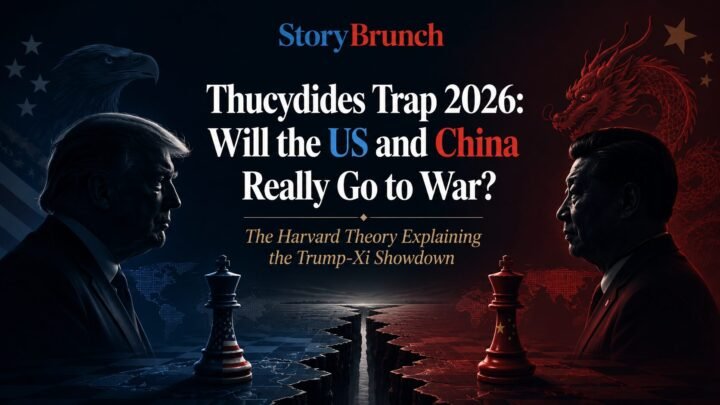
Thucydides Trap 2026: Will the US and China Really Go to War? The Harvard Theory Explaining the Trump-Xi Showdown

The Thucydides Trap: Will the US and China Go to War?
A 2,500-year-old Greek warning has become the most quoted idea in Beijing and Washington. Twelve out of sixteen times in history, a rising power and a ruling power ended up at war. Today, it’s China and America. The question isn’t academic anymore.
When a rising power threatens a ruling one, history says the result is rarely peaceful.
Somewhere in a Beijing meeting room earlier this month, the most powerful man in China sat across from the most powerful man in America and quietly invoked a Greek historian who died nearly 2,400 years ago. The reference wasn’t accidental. It rarely is when Xi Jinping is doing the talking.
The Greek was Thucydides. The idea is the Thucydides Trap. And it might be the single most important framework for understanding whether your grandchildren grow up in a peaceful world — or one rearranged by a war between the two most powerful nations alive.
Two old men, one very old idea
When ancient Athens started flexing its growing power across the Aegean, Sparta — the established hegemon of the day — got nervous. Nervous powers do nervous things. The Peloponnesian War followed, dragged on for 27 brutal years, and effectively ended Greek civilisation as anyone had known it.
Thucydides, who fought in that war and then wrote its history, distilled the entire tragedy into a sentence historians still quote at one another in seminar rooms: “It was the rise of Athens, and the fear that this instilled in Sparta, that made war inevitable.”
Now fast-forward roughly two and a half millennia. Replace Athens with China. Replace Sparta with the United States. Then look at the headlines for the past week.
The Harvard professor who turned a Greek line into a global obsession
We can probably thank — or blame — one man for the fact that “Thucydides Trap” now turns up in everything from Pentagon briefings to viral TikToks.
Graham Allison, a Harvard professor and former US Assistant Secretary of Defense, popularised the phrase in a 2012 Financial Times piece and built it into a 2017 bestseller, Destined for War. His team at Harvard’s Belfer Center went back through 500 years of history and identified 16 cases in which a rising power had genuinely threatened a ruling one.
The result is the statistic that should keep diplomats awake at night.
The Allison Index · 500 Years of Great-Power Rivalry
Out of 16 historical cases of a rising power meeting a ruling power, 12 ended in war.
Source: Belfer Center, Harvard Kennedy School. Allison’s “ruling power vs rising power” dataset covers the years 1500–2010, including Spain vs Portugal in the 16th century, Britain vs Germany before 1914, and the Cold War between the US and the USSR.
Three-in-four. Bookmakers do not call those good odds.
But — what about the four cases that didn’t end in war?
This is the bit Allison badly wants you to remember. History rhymes, but it does not have to repeat. Four times — including the Cold War between Washington and Moscow — leaders found ways to manage the rivalry without firing the missiles.
Henry Kissinger, in his blurb for Allison’s book, expressed the hope with classic understatement: “I can only hope that the US-China relationship becomes the fifth case to resolve itself peacefully, rather than the 13th to result in war.”
That sentence is so calmly terrifying it deserves to be read twice.
Why China and America fit the pattern so neatly
Look at the boxes the trap requires you to tick:
A rising power growing fast enough to upend the global order? China’s GDP has multiplied roughly forty-fold in forty years. By purchasing-power measures, it overtook America’s economy more than a decade ago.
A ruling power determined not to slip into second place? “Make America Great Again” is essentially the trap’s slogan, compressed into 280 characters.
Civilisational pride on both sides? Both nations genuinely believe they are exceptional, blessed, and entitled to set the rules everyone else lives by. Neither is interested in playing second fiddle for the rest of the century.
A long list of issues that could spark a crisis? Here, take your pick.
The Flashpoints · Where a Spark Could Land
In short: yes, this case fits the historical template uncomfortably well.
The Taiwan question: 100 miles of very dangerous water
When experts war-game the path from competition to catastrophe, the road almost always runs through Taiwan.
Beijing considers the island a renegade province that must — eventually — return. Washington maintains “strategic ambiguity” about whether it would defend Taiwan militarily, which is diplomatic code for probably, please don’t make us prove it. Taiwan itself, meanwhile, manufactures roughly 90% of the world’s most advanced semiconductors, which means an invasion would not be a regional conflict. It would be a global economic earthquake measured in the trillions.
When Xi met Donald Trump in Beijing on May 14, China made clear that Taiwan was “front and centre.” Xi reportedly warned the American president of potential “conflict” if the issue wasn’t “handled properly.” Behind the diplomatic phrasing was a stark reminder: Beijing has not changed its mind, and patience is finite.
The May 2026 summit — and why the world exhaled (a little)
The Trump-Xi summit in Beijing, the first US state visit to China since 2017, did not end with anyone signing a peace treaty. There were no breakthroughs on Taiwan. No grand bargain. No televised handshake over the ongoing Iran war. But something quietly important did happen.
The trade war that defined 2025 — when tariffs briefly soared above 100% on both sides — was formally cooled. The two governments agreed on what they called “constructive strategic stability” as a guiding framework for the next three years. Trump invited Xi for a return visit to the White House in September. American CEOs from Tim Cook to Elon Musk to Jensen Huang flew in alongside the presidential delegation, signalling that whatever else this rivalry is, it is also irretrievably entangled in profit.
Allison himself called it “stabilisation.” Not friendship. Not partnership. Just enough mutual interest to keep the fighter jets in their hangars while the diplomats keep talking. In Thucydides Trap terms, that is roughly the best outcome currently available.
Three reasons this time might actually be different
It is worth pushing back gently against the doom loop, because the historical comparison has limits.
Nuclear weapons. Sparta did not have intercontinental ballistic missiles. Any direct US-China war is, almost by definition, civilisational suicide for both sides. That concentrates minds in a way the Greeks never had to consider.
Economic interdependence. China is one of America’s largest trading partners. American consumers fund Chinese factories; Chinese savings finance a chunk of American debt. “Decoupling” is talked about endlessly in Washington; total separation is essentially impossible.
Demographics. China is ageing faster than any major economy in modern history. Some analysts now argue that Beijing’s window to act on Taiwan is narrowing rather than widening — which can cut either way, but it does complicate the simple “unstoppable rising power” picture.
So — will they actually go to war?
The honest answer is the most uncomfortable one: probably not on purpose. Quite possibly by accident. Almost certainly not this year.
If you wanted one sentence to take away from a 2,500-year-old idea, it would be this. The Thucydides Trap is a warning, not a prophecy. The trap is real. The trap has snapped shut twelve times. But four times, very smart people kept it open by working very hard at being unromantic about power, pride, and patience.
Right now, in May 2026, both Xi and Trump appear — at least publicly — to know exactly what game they are playing. Whether that holds through the next Taiwan crisis, the next AI breakthrough, the next ship that gets too close to another ship in the South China Sea, and the next election shock on either side of the Pacific, is the question that will define the rest of the 21st century.
For now, the trap is still open. Just barely.
Reader Questions
Quick Answers on the Thucydides Trap
What is the Thucydides Trap in simple terms?
It is the idea that when a fast-rising power threatens to displace an established one, war is statistically the most likely outcome. The framework is built on 16 historical cases over 500 years — 12 of which ended in armed conflict between the rival powers.
Who coined the term “Thucydides Trap”?
Harvard professor Graham Allison popularised the phrase in a 2012 Financial Times article and expanded it into his bestselling 2017 book Destined for War: Can America and China Escape Thucydides’s Trap? The underlying idea, of course, comes from the ancient Greek historian Thucydides himself.
Will the US and China actually go to war?
There is no consensus, but most analysts believe direct war is not inevitable. Nuclear deterrence, economic interdependence, and the personal stakes for both leaderships work against it. Taiwan remains the single most dangerous flashpoint where a miscalculation could escalate quickly.
What happened at the May 2026 Trump-Xi summit in Beijing?
The two leaders did not reach major agreements on Taiwan or the ongoing Iran war, but they extended the 2025 tariff truce and committed to a “strategic stability” framework for the next three years. Xi accepted Trump’s invitation to a reciprocal White House visit in September 2026.
Why is Taiwan so central to the US-China rivalry?
Three reasons: Beijing considers the island sovereign Chinese territory; Taiwan produces around 90% of the world’s most advanced semiconductors; and any Chinese military move would force Washington into the binary choice it has spent decades trying to avoid.